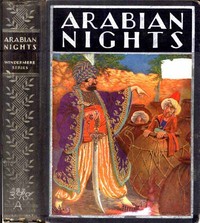
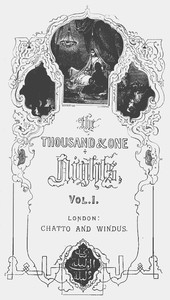
The learned world at first refused to believe that M. Galland had not invented the tales. But he had really discovered an Arabic manuscript from sixteenth-century Egypt, and had consulted Oriental story-tellers. In spite of inaccuracies and loss of color, his twelve volumes long remained classic in France, and formed the basis of our popular translations.
A more accurate version, corrected from the Arabic, with a style admirably direct, easy, and simple, was published by Dr. Jonathan Scott in 1811. This is the text of the present edition.
The Moslems delight in stories, but are generally ashamed to show a literary interest in fiction. Hence the world's most delightful story book has come to us with but scant indications of its origin. Critical scholarship, however, has been able to reach fairly definite conclusions.
The reader will be interested to trace out for himself the similarities in the adventures of the two Persian queens, Schehera-zade, and Esther of Bible story, which M. de Goeje has pointed out as indicating their original identity (Encyclopaedia Britannica, "Thousand and One Nights"). There are two or three references in tenth-century Arabic literature to a Persian collection of tales, called The Thousand Nights, by the fascination of which the lady Schehera-zade kept winning one more day's lease of life. A good many of the tales as we have them contain elements clearly indicating Persian or Hindu origin. But most of the stories, even those with scenes laid in Persia or India, are thoroughly Mohammedan in thought, feeling, situation, and action.
The favorite scene is "the glorious city," ninth-century Bagdad, whose caliph, Haroun al Raschid, though a great king, and heir of still mightier men, is known to fame chiefly by the favor of these tales. But the contents (with due regard to the possibility of later insertions), references in other writings, and the dialect show that our Arabian Nights took form in Egypt very soon after the year 1450. The author, doubtless a professional teller of stories, was, like his Schehera-zade, a person of extensive reading and faultless memory, fluent of speech, and ready on occasion to drop into poetry. The coarseness of the Arabic narrative, which does not appear in our translation, is characteristic of Egyptian society under the Mameluke sultans. It would have been tolerated by the subjects of the caliph in old Bagdad no more than by modern Christians.
More fascinating stories were never told. Though the oath of an Oriental was of all things the most sacred, and though Schah-riar had "bound himself by a solemn vow to marry a new wife every night, and command her to be strangled in the morning," we well believe that he forswore himself, and granted his bride a stay of execution until he could find out why the ten polite young gentlemen, all blind of the right eye, "having blackened themselves, wept and lamented, beating their heads and breasts, and crying continually, 'This is the fruit of our idleness and curiosity.'" To be sure, when the golden door has been opened, and the black horse has vanished with that vicious switch of his tail, we have a little feeling of having been "sold,"--a feeling which great art never gives. But we are in the best of humor; for were we not warned all along against just this foible of curiosity, and is not the story-teller smiling inscrutably and advising us to be thankful that we at least still have our two good eyes?
Beside the story interest, the life and movement of the tales, the spirits that enter and set their own precedents, there is for us the charm of mingling with men so different from ourselves: men adventurous but never strenuous, men of many tribulations but no perplexities. Fantastic, magnificent, extravagant, beautiful, gloriously colored, humorous--was ever book of such infinite contrasts?
The book keeps going
Keep reading, and see it illustrated
Reading is free forever. Sign up and watch scenes appear while you read.
Scenes Storieta drew for other classics.