Public-domain ebook
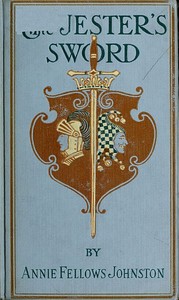
The Jester's Sword How Aldebaran, the King's Son Wore the Sheathed Sword of Conquest
Language: en367 downloads on Project Gutenberg
Subjects
Public-domain ebook sourced from Project Gutenberg #39385.
Public-domain ebook
Language: en367 downloads on Project Gutenberg
Subjects
Public-domain ebook sourced from Project Gutenberg #39385.
The opening · free to read
BECAUSE he was born in Mars' month, which is ruled by that red war-god, they gave him the name of a red star--Aldebaran; the red star that is the eye of Taurus. And because he was born in Mars' month, the bloodstone became his signet, sure token that undaunted courage would be the jewel of his soul.
Now all his brothers were as stalwart and as straight of limb as he, and each one's horoscope held signs foretelling valorous deeds. But Aldebaran's so far out-blazed them all, with comet's trail and planets in most favourable conjunction, that from his first year it was known the Sword of Conquest should be his. This sword had passed from sire to son all down a line of kings. Not to the oldest one always, as did the throne, though now and then the lot fell so, but to the one to whom the signs all pointed as being worthiest to wield it.
So from the cradle it was destined for Aldebaran, and from the cradle it was his greatest teacher. His old nurse fed him with such tales of it, that even in his play the thought of such an heritage urged him to greater ventures than his mates dared take. Many a night he knelt beside his casement, gazing through the darkness at the red eye of Taurus, whispering to himself the words the old astrologers had written, "_As Aldebaran the star shines in the heavens, Aldebaran the man shall shine among his fellows._"
Day after day the great ambition grew within him, bone of his bone and strength of his sinew, until it was as much a part of him as the strong heart beating in his breast. But only to one did he give voice to it, to the maiden Vesta, who had always shared his play. Now it chanced that she, too, bore the name of a star, and when he told her what the astrologers had written, she repeated the words of her own destiny:
"_As Vesta the star keeps watch in the heavens above the hearths of mortals, so Vesta the maiden shall keep eternal vigil beside the heart of him who of all men is the bravest._"
When Aldebaran heard that he swore by the bloodstone on his finger that when the time was ripe for him to wield the sword he would show the world a far greater courage than it had ever known before. And Vesta smiling, promised by that same token to keep vigil by one fire only, the fire that she had kindled in his heart.
One by one his elder brothers grew up and went out into the world to win their fortunes, and like a restless steed that frets against the rein, impatient to be off, he chafed against delay and longed to follow. For now the ambition that had grown with his growth had come to be more than bone of his bone and strength of his sinew. It was an all-consuming desire which coursed through him even as his heart's blood; for with the years had come an added reason for the keeping of his youthful vow. Only in that way could Vesta's destiny be linked with his.
When the great day came at last for the Sword to be put into his hands, with a blare of trumpets the castle gates flew open, and a long procession of nobles filed through. To the sound of cheers and ringing of bells, Aldebaran fared forth on his quest. The old king, his father, stepped down in the morning sun, and with bared head Aldebaran knelt to receive his blessing. With his hand on the Sword he swore that he would not come home again, until he had made a braver conquest than had ever been made with it before, and by the bloodstone on his finger the old king knew that Aldebaran would fail not in the keeping of that oath.
With the godspeed of the villagers ringing in his ears, he rode away. Only once he paused to look back, when a white hand fluttered at a casement, and Vesta's sorrowful face shone down on him like a star. Then she, too, saw the bloodstone on his finger as he waved her a farewell, and she, too, knew by that token he would fail not in the keeping of his oath.
'Twas passing wonderful how soon Aldebaran began to taste the sweets of great achievement. His name was on the tongue of every troubadour, his deeds in every minstrel's song. And though he travelled far to alien lands, scarce known by hearsay even to the folk at home, his fame was carried back, far over seas again, and in his father's court his name was spoken daily in proud tones, as they recounted all his honours.
Young, strong, with the impetuous blood begotten of success tingling through all his veins, he had no thought that dire mishap could seize on him; that pain or malady or mortal weakness could pierce his armour, which youth and health had girt about him. From place to place he went, wherever there was need of some brave champion to espouse a weak ones cause. It mattered not who was arrayed against him, whether a tyrant king, a dragon breathing fire, or some hideous scaly monster that preyed upon the villages. His Sword of Conquest was unsheathed for each; and as his courage grew with every added victory, he thirsted for some greater foe to vanquish, remembering his youthful vow.
And as he journeyed on he pictured often to himself the day of his returning, the day on which his vow should find fulfilment. How wide the gates would be thrown open for his welcome! How loud would swell the cheers of those who thronged to do him honour! His dreams were always of that triumphal entrance, and of Vesta's approving smile. Never once the shadow of a thought stole through his mind that it might be far otherwise. Was not he born for conquest? Did not the very stars foretell success?
One night, belated in a mountain pass, he sought the shelter of a shelving rock, and with his mantle wrapped about him lay down to sleep. Upon the morrow he would sally forth and beard the Province Terror in his stronghold; would challenge him to combat, and after long and glorious battle would rid the country of its dreaded foe. Already tasting victory, he fell asleep, a smile upon his lips.
But in the night a storm swept down the mountain pass with sudden fury, uprooting trees a century old, and rending mighty rocks with sword thrusts of its lightning. And when it passed Aldebaran lay prone upon the earth borne down by rocks and fallen trees. Lay as if dead until two passing goat-herds found him and bore him down in pity to their hut.
Long weeks went by before the fever craze and pains began to leave him, and when at last he crawled out in the sun, he found himself a poor misshapen thing, all maimed and marred, with twisted back and face all drawn awry and foot that dragged. One hand hung nerveless by his side. Never more would it be strong enough to use the Sword. He could not even draw it from its scabbard.
As in a daze he looked upon himself, thinking some hideous nightmare had him in its hold. "That is not I!" he cried, in horror at the thought. Then as the truth began to pierce his soul, he sat with starting eyes and lips that gibbered in cold fear, the while they still persisted in their fierce denial. "This is not I!"
Again he said it and again as if his frenzied words could work a miracle and make him as he was before. Then when the sickening sense of his calamity swept over him like a flood in all its fulness, he cast himself upon the earth and prayed to die. Despair had seized him. But Death comes not at such a call; kind Death, who waits that one may have a chance to rise again and grapple with the foe that downed him, and conquering, wipe the stigma coward from his soul.
So with Aldebaran. At first it seemed that he could not endure to face the round of useless days now stretching out before him. An eagle, broken winged and drooping in a cage, he sat within the goat-herd's hut and gloomed upon his lot, and cursed the vital force within that would not let him die.
To fall asleep with all the world within one's grasp and waken empty-handed--that is small bane to one who may spring up again, and by sheer might wrest all his treasures back from Fortune. But to wake helpless as well as empty-handed, the strength for ever gone from arms that were invincible; to crawl, a poor crushed worm, the mark for all men's pity, where one had thought to win the meed of all men's praise, ah, then to live is agony! Each breath becomes a venomed adder's sting.
Most of all Aldebaran thought of Vesta. The stroke that marred his comeliness and took his strength had robbed him of all power to win his happiness. It was written "by the hearth of him who is the bravest she shall keep eternal vigil." As yet he had not risen above the level of his forbears' bravery, only up to it. Now 'twas impossible to show the world a greater courage, shorn as he was of strength. And even had her horoscope willed otherwise, and she should come to him all filled with maiden pity to share his ruined hearth, he could not say her yea. His man's pride rose up in him, rebellious at the thought of pity from one in whose sight he fain would be all that is strong and comely. Looking down upon his twisted limbs, the pain that racked him was greater torture than mere flesh can feel. Although 'twas casting heaven from him, he drew his mantle closer, hiding his disfigured form, and prayed with groans and writhings that she might never look on him again. So days went by.
There came a time when, even through his all-absorbing thought of self, there pierced the consciousness that he no longer could impose upon the goat-herds' bounty. Food was scarce within the hut, and even though he groaned to die, the dawns brought hunger. So at the close of day he dragged him down the mountainside, thinking that under cover of the dusk he would steal into the village and seek a chance to earn his bread.
But as he neared the little town and the sound of evening bells broke on his ear, and lighted windows marked the homes where welcome waited other men, he winced as from a blow. This was the village he had thought to enter in the midst of loud acclaims, its brave deliverer from the Province Terror. Then every window in the hamlet would have blazed for him. Then every door would have been set wide to welcome Aldebaran, the royal son of kings, fittest to bear the Sword of Conquest. And now Aldebaran was but the crippled makeshift of a man, who could not even draw that Sword from out its scabbard; at whose wry features all must turn away in loathing, and some perchance might even set the dogs to snarling at his heels, in haste to have him gone.
"In all the world," he cried in bitterness, "there breathes no other man whom Faith hath used so cruelly! Emptied of hope, robbed of my all, life doth become a prison-house that dooms me to its lowest dungeon! Why struggle any longer 'gainst my lot? Why not lie here and starve, and thus force Death to turn the key, and break the manacles which bind me to my misery?"
While he thus mused, footsteps came up the mountainside, a lusty voice was raised in song, and before he could draw back into cover, a head in a fantastic cap appeared above the bushes. It was the village Jester capering along the path as if the world were thistledown and every day a holiday. But when he saw Aldebaran he stopped agape and crossed himself. Then he pushed nearer.
The book keeps going
Reading is free forever. Sign up and watch scenes appear while you read.



Scenes Storieta drew for other classics.
New illustrated classics
Once or twice a month: the latest books to get full character casts, scene art, and free comic editions. No account needed.