PREFACE.
Some years ago, when living on an orange grove at Winter Park, it occurred to me that my idle time might be usefully employed in transcribing from memoranda and my diary many incidents of my life for preservation in one manuscript for my children. This was continued at intervals until it became as here presented. It was mainly discontinued after my children became old enough to observe passing events for themselves.
But inasmuch as a few books have been published containing errors in describing some military operations in which I participated, justice to the troops under my command induces me to publish my account of them as recorded when they occurred.
This volume, then, is a simple narrative of passing events, without discussing their importance and bearing politically in shaping the destiny of the nation.
Although my lot was cast with the South, and whatever may be my opinion of the action of the North before, during, and after the war as expressed in these pages, I am as loyal to the Constitution and as ready to uphold and maintain the rights and dignity of the United States as any man within its boundary; and this was evidenced when I tendered my services, as a soldier, to the President before war was declared against Spain.
I do not know that I am indebted to any person, except Joseph M. Brown, of Marietta, Ga., a son of Gov. Joseph E. Brown, for what I have written, and to him I make acknowledgment for obligations.
THE AUTHOR.
Pensacola, Fla., May 1. 1899.
INTRODUCTION.
Of all forms of history, a good autobiography is the most pleasing and attractive. If the writer has been a prominent and responsible participant in great events, if high character warrants his faithfulness to truth, and if the events of which he writes are in themselves of great historic value, his autobiography will possess a peculiar charm and interest for every intelligent reader.
The generation that recalls from memory the events of our history connected with the admission of the great State of Texas into the American Union and the war with Mexico which followed has nearly all gone. Here and there a strong man survives whose memory is clear and whose conscience is true. To hear him talk of these events, or to read after him as he writes of the universal excitement in the country--the angry debates in Congress, the opposition to the admission of Texas, and to the war with Mexico, the brilliant campaign of Taylor, the battles of Palo Alto, Resaca de la Palma, Monterey, and Buena Vista--is to enjoy history in its most attractive form. The historian who has been an active participant in the events of which he writes, whose passions have been cooled by age, and whose judgment has been disciplined by long years of experience and reflection enjoys an immense advantage. However we may disagree with him in his criticisms upon the conduct of men or upon their motives, if he be a man of high and true character, we enjoy the greatest satisfaction in accepting his positive statements as to facts which represent his own actions and experiences.
Gen. French is such a historian. The clear, natural, dispassionate style of his book--its freedom from bitterness, the tenderness with which he dwells upon the history of his classmates at West Point, several of whom became distinguished generals in the Federal army (Grant, Franklin, Ingalls, and Quinby)--all these characteristics of his autobiography soon win the confidence of the reader.
For the general reader of to-day, and especially for the survivors of the Confederate Army, Gen. French's autobiography will possess peculiar interest. The writer has enjoyed the opportunity of reading the advance sheets of the book only through the account of the battle of Allatoona, which was fought October 5, 1864, but as Gen. French participated in the campaign of Gen. Hood up to its predestined disaster at Nashville, the autobiography will be read with more than usual interest by students of the ill-starred march into Tennessee and the battles of Franklin and Nashville.
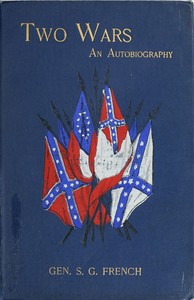
The venerable author of "Two Wars" has been an able and gallant soldier of his country, and the simple and graphic manner in which he writes of his distinguished services, and relates the great events in which he bore a faithful part, entitle his book to the confidence of his countrymen. It is a most valuable addition to our country's history, and a book which will be of permanent use in the study of our great Confederate struggle.
ELLISON CAPERS.
Columbia, S. C., July 1, 1901.
CONTENTS.
The book keeps going
Keep reading, and see it illustrated
Reading is free forever. Sign up and watch scenes appear while you read.
Scenes Storieta drew for other classics.