Where the Hunt wording is too stilted, the text of the Hausmärchen itself has been followed. The very long sentences have been subdivided. While that quaint old-fashioned translation, illustrated with woodcuts by Wehnert, has contributed its bit of folk phraseology. The Editor’s desire is to restore to the children as large a collection as possible of Grimm’s Fairy Tales unmutilated in their literary perfection.
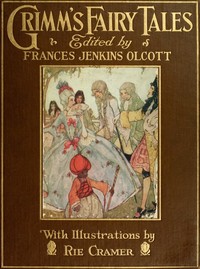
The illustrations are by the well-known Dutch artist, Mrs. Rie Cramer. Some of Rie Cramer’s other fairy tale pictures published in England, are said by admiring critics there, to be very charming, of exceptional merit, and to have high artistic merit of their own.
Her illustrations for Grimm are particularly harmonious in color, while their quaint charm grows on one more and more as one lives with them. They are fanciful or humorous. They have the quality, rare in fairy tales, of actually illustrating their text. This will mean added pleasure to the children. Rie Cramer’s little black and white headings are particularly pretty and graceful in outline.
The tales are presented here in their original form, with nothing left out of child-heartedness, humor, poetic feeling, and delicate sentiment and fancy. Indeed, it is all here--the poesy and purity which those profound and child-loving scholars, the Brothers Grimm, retained in the old folk-tales which, with so much pains, they gathered largely from among the peasant-folk themselves.
And the Brothers explained, in their preface, that they had planned the volume as an educational book as well as one for scholars; for which reason they had eliminated everything which they feared might harm the children. But since the Brothers issued their book, about a hundred years ago, educational requirements of what is ethically best for children have materially advanced. Therefore, in this book, a few other parts unsuitable for children have been omitted.
So now this volume of Grimm’s Fairy Tales is offered to our American boys and girls; and may they have continued delight in the beautiful old folk-fictions, which have come down to us from the fresh and sparkling meadows and woods of ancient days.
Fathers and mothers, too, will enjoy reading the tales aloud and sharing with the children the humor and the deep but simple ethical truths so tenderly and poetically set forth therein.
Teachers and story-tellers, also, may find in this sincere version, rich material for kindling the imagination and feeding the poetic fancy of their pupils.
The Editor, FRANCES JENKINS OLCOTT.
The Editor’s acknowledgments are due to the following texts:
Kinder und Hausmärchen, following the last edition authorized by William Grimm with the Grimm Introduction on the origin and educational use of the tales.
Household Stories, illustrated by Wehnert, first published in London, 1853.
But most especially to Household Tales, with the Author’s notes, translated by Margaret Hunt, introduction by Andrew Lang, Bohn Library.
For the use of the Hunt text the Editor gratefully acknowledges the gracious permission of Messrs. Harcourt, Brace and Company, American Publishers of the Bohn Library.
The book keeps going
Keep reading, and see it illustrated
Reading is free forever. Sign up and watch scenes appear while you read.
Scenes Storieta drew for other classics.