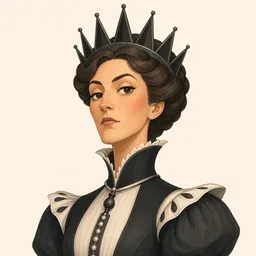
Red Queen
Also known as the Queen
A strict and authoritative figure who governs the landscape of the looking-glass world. She is much more commanding and intimidating than the White Queen.
View character profileCharacter guide
Who's who in Through the Looking-Glass by Lewis Carroll: meet the 7 main characters, see how they connect, and open a detailed profile for each.
7 illustrated profiles
Also known as the Queen
A strict and authoritative figure who governs the landscape of the looking-glass world. She is much more commanding and intimidating than the White Queen.
View character profile
Also known as the Queen
A gentle, somewhat scatterbrained, and ethereal character who moves through the world with a dreamy, distracted demeanor.
View character profile
Also known as one of the twins, the twin
One of the identical twin brothers who encounter Alice; they are mischievous and prone to reciting nonsensical poems.
View character profile
Also known as one of the twins, the twin
The twin brother of Tweedledum, known for his playful and somewhat argumentative personality.
View character profile
An eccentric, egg-shaped character who engages Alice in a debate about the meaning of words.
View character profile
Also known as the White Knight, the Knight
A gentle, clumsy, and highly inventive character who attempts to help Alice but is prone to falling off his horse.
View character profile
Also known as the King, the sleeping King
A character listed in the dramatis personae as part of the Red side of the game.
View character profile
Storieta keeps this cast at your side while you read Through the Looking-Glass, portraits, names, and an ask-anything assistant that only knows what you've read so far. No spoilers, ever.
Explore the book page for Through the Looking-Glass and read the opening free, with no account needed.
Lewis Carroll’s fantasy fiction sends Alice into a world shaped like a chessboard, where ordinary rooms, books, games, and household objects become strange and animate. From a cozy room beside a snowy window, her habit of pretending carries her through the looking-glass into a reversed counterpart of home, complete with living chess pieces and a game whose moves map the adventures ahead. The result is a journey through imaginary places filled with curious figures, playful rules, and transformations.
The voice is witty, observant, dreamlike, and gently mischievous, shifting between intimate conversation and elaborate nonsense while treating the impossible with perfect seriousness. Carroll’s Victorian prose combines nursery-tale warmth with intricate wordplay, formal riddles, theatrical entrances, and the logic of a chess problem. It will appeal to children and adults who enjoy imaginative fantasy, talking creatures, linguistic puzzles, and stories that invite make-believe rather than explain every marvel. Alice’s candid curiosity and determined questioning give the book an engaging guide through its topsy-turvy world.
Every cast illustrated from the original text.