COUNTY OF GALWAY.
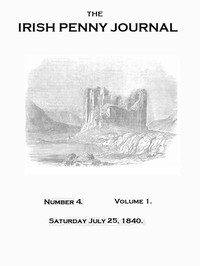
Not many years since there was an extensive district in the west of Ireland, which, except to those inhabiting it, was a sort of terra incognita, or unknown region, to the people of the British isles. It had no carriage roads, no inns or hotels, no towns; and the only notion popularly formed of it was that of an inhospitable desert--the refugium of malefactors and Irish savages, who set all law at defiance, and into which it would be an act of madness for any civilized man to venture. This district was popularly called the Kingdom of Connemara, a name applied to that great tract extending from the town of Galway to the Killery harbour, bounded on the east by the great lakes called Lough Corrib and Lough Mask, and on the west by the Atlantic Ocean, and comprising within it the baronies of Moycullen and Ballinahinch, and the half barony of Ross. It is not an unknown region now. It has two prosperous towns and several villages, good roads, and comfortable hotels. "The Queen's writ will run in it;" and the inhabitants are remarkable for their intelligence, quietness, honesty, hospitality, and many other good qualities; and in the summer months it is the favourite resort of the artist, antiquary, geologist, botanist, ornithologist, sportsman--in short, of pleasure tourists of all descriptions, and from every quarter of the British empire; for it is a district singularly rich in its attractions to all those who look for health and pleasure from a summer's ramble, combined with excitable occupation. Of its picturesque beauties much has already been written. They have been sketched by the practised hand of Inglis, and by the more graphic pencil of Cæsar Otway; but its history and more important antiquities have been as yet but little noticed, and, consequently, generally passed by without attracting the attention or exciting any interest in the mind of the traveller. We propose to ourselves to supply this defect to some extent, and have consequently chosen as the subject of our first illustration the ancient castle, of which we have presented our readers with a view, and which is the most picturesque, and, indeed, important remain of antiquity within the district which we have described.
Journeying along the great road from Galway to Oughterard, and at the distance of about two miles from the latter, the attention of the traveller will most probably be attracted by a beautiful little river, over which, on a natural bridge of limestone rock, the road passes; and looking to the right, towards the wide expanse of the waters of Lough Corrib, he will perceive the grey tower or keep of an extensive castle, once the chief seat or fortress of the O'Flaherties, the hereditary lords of West Connaught, or Connemara. This castle is called the Castle of Aughnanure, or, properly, Achaidh-na-n-Jubhar, Acha-na-n-ure, or the field of the yews--an appellation derived from the number of ancient trees of that description which grew around it, but of which only a single tree now survives. This vestige is, however, the most ancient and interesting ruin of the locality. Its antiquity must be great indeed--more than a thousand years; and, growing as it does out of a huge ledge of limestone rock, and throwing its withered and nearly leafless branches in fantastic forms across the little river which divides it from the castle, the picturesqueness of its situation is such as the painter must look at with feelings of admiration and delight. It has also its historical legend to give it additional interest; and unfortunately this legend, though quite in harmony with the lone and melancholy features of the scene, is but too characteristic of the unhappy social and political state of Ireland at the period to which it relates--the most unfortunate period, as it may be emphatically called, of Ireland's history--that of the civil wars in the middle of the seventeenth century. The principle, however, which we propose to ourselves in the conducting of our publication, will not permit us to give this legend a place in its pages; it may be learned on the spot; and we have only alluded to it here, in order to state that it is to the religious veneration kept alive by this tradition that the yew tree of Aughnanure owes its preservation from the fate which has overtaken all its original companions.
The Castle of Aughnanure, though greatly dilapidated by time, and probably still more so by the great hurricane of last year, is still in sufficient preservation to convey to those who may examine its ruins a vivid impression of the domestic habits and peculiar household economy of an old Irish chief of nearly the highest rank. His house, a strong and lofty tower, stands in an ample court-yard, surrounded by outworks perforated with shot-holes, and only accessible through its drawbridge gateway-tower. The river, which conveyed his boats to the adjacent lake, and supplied his table with the luxuries of trout and salmon, washes the rock on which its walls are raised, and forms a little harbour within them. Cellars, bake-houses, and houses for the accommodation of his numerous followers, are also to be seen; and an appendage not usually found in connection with such fortresses also appears, namely, a spacious banqueting-hall for the revels of peaceful times, the ample windows of which exhibit a style of architecture of no small elegance of design and execution.
We shall probably in some early number of our Journal give a genealogical account of the noble family to whom this castle belonged; but in the mean time it may be satisfactory to the reader to give him an idea of the class of persons by whom the chief was attended, and who occasionally required accommodation in his mansion. They are thus enumerated in an ancient manuscript preserved in the College Library:--O'Canavan, his physician; Mac Gillegannan, chief of the horse; O'Colgan, his standard-bearer; Mac Kinnon and O'Mulavill, his brehons, or judges; the O'Duvans, his attendants on ordinary visitings; Mac Gille-Kelly, his ollave in genealogy and poetry; Mac Beolain, his keeper of the black bell of St Patrick; O'Donnell, his master of revels; O'Kicherain and O'Conlachtna, the keepers of his bees; O'Murgaile, his chief steward, or collector of his revenues.
The date of the erection of this castle is not exactly known, though it was originally inscribed on a stone over its entrance gateway, which existed in the last century. From the style of its architecture, however, it may be assigned with sufficient certainty to the middle of the sixteenth century, with the exception, perhaps, of the banqueting-hall, which appears to be of a somewhat later age.
While the town of Galway was besieged in 1651 by the parliamentary forces under the command of Sir Charles Coote, the Castle of Aughnanure afforded protection to the Lord Deputy the Marquess of Clanricarde, until the successes of his adversaries forced him and many other nobles to seek safety in the more distant wilds of Connemara. This event is thus stated by the learned Roderick O'Flaherty in 1683:--
"Anno 1651.--Among the many strange and rare vicissitudes of our own present age, the Marquis of Clanricarde, Lord Deputy of Ireland, the Earl of Castlehaven, and Earl of Clancarty, driven out of the rest of Ireland, were entertained, as they landed on the west shore of this lake for a night's lodging, under the mean roof of Mortough Boy Branhagh, an honest farmer's house, the same year wherein the most potent monarch of Great Britain, our present sovereign, bowed his imperial triple crown under the boughs of an oak tree, where his life depended on the shade of the tree leaves."
There are several of the official letters of the Marquis preserved in his Memoirs, dated from Aughnanure, and written during the stormy period of which we have made mention.
The Castle of Aughnanure has passed from the family to whom it originally belonged; but the representative and the chief of his name, Henry Parker O'Flaherty, Esq. of Lemonfield, a descendant in the female line from the celebrated Grania Waille, still possesses a good estate in its vicinity. P.
THE IRISH IN ENGLAND.
NO. 1.--THE WASHERWOMAN.
BY MRS S. C. HALL.
The only regular washerwomen extant in England at this present moment, are natives of the Emerald Isle.
We have--I pray you observe the distinction, gentle reader--laundresses in abundance. But washerwomen!--all the washerwomen are Irish.
The Irish Washerwoman promises to wash the muslin curtains as white as a hound's tooth, and as sweet as "new mown hay;" and she tells the truth. But when she promises to "get them up" as clear as a kitten's eyes, she tells a story. In nine cases out of ten, the Irish Washerwoman mars her own admirable washing by a carelessness in the "getting up." She makes her starch in a hurry, though it requires the most patient blending, the most incessant stirring, the most constant boiling, and the cleanest of all skillets; and she will not understand the superiority of powder over stone blue, but snatches the blue-bag (originally compounded from the "heel" or "toe" of a stocking) out of the half-broken tea-cup, where it lay companioning a lump of yellow soap since last wash--squeezes it into the starch (which, perhaps, she has been heedless enough to stir with a dirty spoon), and then there is no possibility of clear curtains, clear point, clear any thing.
"Biddy, these curtains were as white as snow before you starched them."
"Thrue for ye, ma'am dear."
"They are blue now, Biddy."
"Not all out."
"No, Biddy, not all over--only here and there."
"Ah, lave off, ma'am, honey, will ye?--'tisn't that I mane; but there's a hole worked in the blue-rag, bad luck to it, and more blue nor is wanting gets out; and the weary's in the starch, it got lumpy."
"It could not have got 'lumpy' if it had been well blended."
"It was blended like butther; but I just left off stirring one minute to look at the soldiers."
"Ah, Biddy, an English laundress would not 'run after the soldiers!'"
Such an observation is sure to offend Biddy's propriety, and she goes off in a "huff," muttering that if they didn't go "_look_ afther them, they'd skulk afther them; it's the London Blacks does the mischief, and the mistress ought to know that herself. English laundresses indeed! they haven't power in their elbow to wash white."
Biddy says all this, and more, for she is a stickler for the honour of her country, and wonders that I should prefer any thing English to every thing Irish. But the fact remains the same.
The actual labour necessary at the wash-tub is far better performed by the Irish than the English; but the order, neatness, and exactness required in "the getting up," is better accomplished by the English than the Irish. This is perfectly consistent with the national character of both countries.
Biddy Mahony is without exception the most useful person I know, and she knows it also; and yet it never makes her presuming. It is not only as a washerwoman that her talent shines forth: she gets through as much hard work as two women, though, as she says herself, "the mistress always finds fault with her finishing touches." There she stands, a fine-looking woman still, though not young; her large mouth ever ready with its smile; her features expressive of shrewd good humour; and her keen grey eyes alive and about, not resting for a moment, and withal cunning, if not keen; the borders of her cap are twice as deep as they need be, and flap untidily about her face; she wears a coloured handkerchief inside a dark blue spotted cotton gown, which wraps loosely in front, where it is confined by the string of her apron; her hands and wrists have a half-boiled appearance, which it is painful to look at--not that she uses as much soda as an English laundress, but she does not spare her personal exertions, and rubs most unmercifully. One bitter frosty day last winter, I saw Biddy standing near the laundry window, stitching away with great industry.