THE IRISH PENNY JOURNAL.
NUMBER 4. SATURDAY, JULY 25, 1840. VOLUME 1.
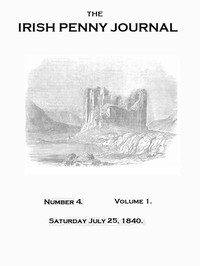
Our prefixed illustration gives a near view of one of the most interesting ruins now remaining in the romantic region of Connemara, or the Irish Highlands, and which is no less remarkable for its great antiquity than for the singularly wild and picturesque character of its situation, and that of its surrounding scenery. It is the feature that gives poetic interest to the most beautiful portion of Lough Corrib--its upper extremity--where a portion of the lake, about three miles in length, is apparently surrounded and shut in by the rocky and precipitous mountains of Connemara and the Joyce country, which it reflects upon its surface, without any object to break their shadows, or excite a feeling of human interest, but the one little lonely Island-Castle of the Hen. That an object thus situated--having no accompaniments around but those in keeping with it--should, in the fanciful traditions of an imaginative people, be deemed to have had a supernatural origin, is only what might have been naturally expected; and such, indeed, is the popular belief. If we inquire of the peasantry its origin, or the origin of its name, the ready answer is given, that it was built by enchantment in one night by a cock and a hen grouse, who had been an Irish prince and princess!
There is, indeed, among some of the people of the district a dim tradition of its having been erected as a fastness by an O'Conor, King of Connaught, and some venture to conjecture that this king was no other than the unfortunate Roderick, the last King of Ireland; and that the castle was intended by him to serve as a place of refuge and safety, to which he could retire by boat, if necessity required, from the neighbouring monastery of Cong, in which he spent the last few years of his life: and it is only by this supposition that they can account for the circumstance of a castle being erected by the O'Conors in the very heart of a district which they believe to have been in the possession of the O'Flahertys from time immemorial. But this conjecture is wholly erroneous, and the true founders and age of this castle are to be found in our authentic but as yet unpublished Annals, from which it appears certain that the Hen's Castle was one of several fortresses erected, with the assistance of Richard de Burgo, Lord of Connaught, and Lord Justice of Ireland, by the sons of Roderick, the last monarch of the kingdom. It is stated in the Annals of Connaught, and in the Annals of the Four Masters, at the year 1225, that Hugh O'Conor (son of Cathal Crovedearg), King of Connaught, and the Lord Justice of Ireland, Richard De Burgo, arriving with their English at the Port of Inis Creamha, on the east side of Lough Corrib, caused Hugh O'Flaherty, the Lord of West Connaught, to surrender the island of Inis Creamha, Oilen-na-Circe, or the Hen's Island, and all the vessels of the lake, into Hugh O'Conor's hands, for assurance of his fidelity.
From this entry it would appear that the Hen's Island, as well as the island called Inis Creamha, had each a castle on it previously; and this conclusion is strengthened by a subsequent entry in the same Annals, at the year 1233, from which it appears that this castle, as well as others, had been erected by the sons of Roderick, who had been long in contention for the government with Cathal Crovedearg, and his sons Hugh and Felim, and had, during these troubles, possessed themselves of O'Flaherty's country. On the death of Hugh O'Conor, who was treacherously slain by Geoffry De Mares, or De Marisco, in 1228, they appear to have again seized on the strongholds of the country, that of the Hen's Castle among the rest, and to have retained them till 1233, when their rival Felim O'Conor finally triumphed, and broke down their castles. This event is thus narrated in the Annals of the Four Masters:--
"1233. Felim, the son of Charles the Red-handed, led an array into Connaught. Cormac, the son of Tomaltagh (Lord of Moylurg), went to meet him, and brought him to Moylurg, where they erected a camp at Druim Greagraighe, and were joined by Cormac, by Conor his son, the inhabitants of the three Tuathas, and by the two sons of Mortogh Mac Dermot, Donogh and Mortogh. They here consulted with each other, and resolved upon going in pursuit of Hugh (King of Connaught) and the other sons of Roderic. After overtaking them, they defeated Hugh, slew himself, his brother, Hugh Muimhneach his son, and Donogh More, the son of Dermot, who was the son of Roderic, and many others besides. There were also slain Raghallach O'Flanigan, Thomas Biris, Constable of Ireland, his relative John Guer, and many other Englishmen. This was after the bells and croziers had been rung against them, after they had been cursed and excommunicated by the clergy of Connaught; for Hugh Muimhneach had violated and plundered Tibohine and many other churches, so that he and his adherents fell in revenge of their dishonour to the saints whose churches they had violated. The kingdom and sovereignty of Connaught were wrested from the sons of Roderic, the son of Torlogh, on that day. Felim, the son of Charles the Red-handed, then assumed the government of Connaught, and demolished the castles which had been erected by the power of the sons of Roderic O'Conor and Mac William Burke, namely, the Castle of Bon Gaillimbe, Caislen-na-Circe, Caislen-na-Caillighe, and the Castle of Dunamon."
In subsequent times the Hen's Castle reverted to the O'Flahertys, and was repaired and garrisoned by them till the time of Cromwell, when, as we are informed by Roderick O'Flaherty, it was finally dismantled and left to decay. Still, however, enough remains to exhibit its original plan, which was that of an Anglo-Norman castle or keep, in the form of a parallelogram, with three projecting towers on its two longest sides; and the architectural features of the thirteenth century are also visible in some of its beautifully executed windows and doorways.
The Hen's Castle is not without its legendary traditions connected with its history anterior to its dilapidation; and the following outline of one of these--and the latest--as told at the cottage firesides around Lough Corrib, may be worth preserving as having a probable foundation in truth.
It is said that during the troubled reign of Queen Elizabeth, a lady of the O'Flahertys, who was an heiress and a widow, with an only child, a daughter, to preserve her property from the grasp of her own family and that of the De Burgos or Burkes, shut herself up with her child in the Hen's Castle, attended by twenty faithful followers, of tried courage and devotion to her service, of her own and her husband's family. As such a step was, however, pregnant with danger to herself, by exciting the attention and alarm of the government and local authorities, and furnishing her enemies with an excuse for aggression, she felt it necessary to obtain the queen's sanction to her proceedings; and accordingly she addressed a letter to her majesty, requesting her permission to arm her followers, and alleging as a reason for it, the disaffected state of the country, and her ardent desire to preserve its peace for her majesty. The letter, after the fashion of the times, was not signed by the lady in her acquired matron's name, but in her maiden one, of which no doubt she was more proud; it was Bivian or Bevinda O'Flaherty. The queen received it graciously; but not being particularly well acquainted with the gender of Irish Christian names, and never suspecting, from the style or matter of the epistle, that it had emanated from one of her own sex, she returned an answer, written with her own hand, authorising her good friend "Captain Bivian O'Flaherty" to retain twenty men at her majesty's expense, for the preservation of the peace of the country; and they were maintained accordingly, till the infant heiress, becoming adult, was united to Thomas Blake, the ancestor of the present Sir John Blake of Menlo Castle, and proprietor of the Castle of the Hen.
To these brief notices of an ancient castle, not hitherto described, or its age ascertained, we shall only add, that there are few military structures of lime and stone now remaining in Ireland that can boast an equal antiquity.
P.
OCCUPATIONS FOR THE YOUNG.
BY MARTIN DOYLE.
Habit is said to be a second nature, and it is often stronger than the first. At first we easily take the bend from the hand of the master, but the second nature, which is of our own making, is frequently proof against any alteration. How important, then, is education, which gives the turn and moulding to the mind while it is flexible, fixes the habits, and forms the character! The discipline of the mind, with respect to its natural bias, is either misdirected or misunderstood in nine cases out of ten, and latent talents or tendencies, which by proper culture might be rendered sources of enjoyment to the possessor, and useful to the community, are restrained, if not too powerful for suppression, from their proper developement, by absurd and artificial treatment.
In the upper classes, a parent, perhaps, incapable of estimating the capacity of his son, determines with himself that the profession, suppose of divinity, of law, or of medicine, is the most lucrative, gentlemanlike, or otherwise eligible, and that the boy shall be educated accordingly.
The unfortunate youth who has no talent for the acquisition of languages, and cannot comprehend the simplest proposition in geometry, is condemned to pursue a prescribed routine, and to pass many of the most precious years of his life in the unavailing effort to learn, through the drudgery of a classical school, what is repugnant to his taste, and beyond his powers of comprehension; and all this time, from being constantly engaged in thumbing the elementary books of the dead languages (which are never at his finger ends, in the acceptation of the common phrase), he grows up shamefully ignorant of his vernacular tongue, in which he can neither read with fluency nor spell with correctness.
The schoolmaster, however, is expected to prepare him for the university within a given time, and he must be made up for entrance accordingly. If the parents are told that Young Hopeful has no turn for a literary life, no capacity for learning what is required, they doubt the judgment of the informant, who tells them the truth; for the acknowledgment of this would be an indirect admission of their own incapacity; and in proportion to their ignorance and dullness, is their self assurance that their booby has excellent abilities. The youth is therefore forced forward in spite of his natural repugnance to books; and if afterwards smuggled through the university into a profession which may give him place or emolument, without ability or exertion on his part, he disgraces his station by general ignorance and unfitness; and if he be admitted into a profession which yields honour or emolument only in proportion to talents and industry, he totally fails of the object, and it is discovered too late that the selection of his avocation was in some way unlucky.