Public-domain ebook
The Irish Penny Journal, Vol. 1 No. 45, May 8, 1841
by Various
Language: en312 downloads on Project Gutenberg
Subjects
In: History - European·Nature/Gardening/Animals
Public-domain ebook sourced from Project Gutenberg #55306.
Public-domain ebook
by Various
Language: en312 downloads on Project Gutenberg
Subjects
In: History - European·Nature/Gardening/Animals
Public-domain ebook sourced from Project Gutenberg #55306.
The opening · free to read
THE IRISH PENNY JOURNAL.
NUMBER 45. SATURDAY, MAY 8, 1841. VOLUME I.
The greyhound! the great hound! the graceful of limb! Rough fellow! tall fellow! swift fellow, and slim! Let them sound through the earth, let them sail o’er the sea, They will light on none other more ancient than thee!
OLD MS.
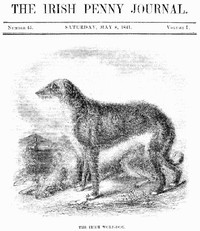
No individual of the canine race has attained an equal amount of fame, or excited an equal degree of attention through Europe, not merely in the days of his acknowledged existence amongst our dogs of chase, but even now, that he is considered to be extinct, with that once possessed by the superb creature whose picture adorns our title-page, and an account of whom forms the subject of the present article. Public opinion has long been divided respecting the precise appearance and form of this majestic animal, and so many different ideas have been conceived of him, that many persons have been induced to come to the conclusion that no particular breed of dogs was ever kept for wolf-hunting in this country, but that the appellation of “wolf-dog” was bestowed upon any dog swift enough to overtake and powerful enough to contend with and overcome that formidable animal. There are those who hold this opinion, and there are likewise those who hold that while a particular breed was used, it was a sort of heavy mastiff-like dog, now extinct. It is the object of the present paper to show that not only did Ireland possess a peculiar race of dogs exclusively devoted to wolf-hunting, but that those dogs, instead of being of the mastiff kind, resembled the greyhound in form; and instead of being extinct, are still to be met with, although we are compelled to acknowledge that they are very scarce. I myself was once in very gross error respecting this dog, for I like many others conceived him to have been a mastiff, and implicitly believed that the dogs of Lord Altamont, described in the 3d vol. of the Linnæan Transactions by Mr Lambert, were the sole surviving representatives of the Irish wolf-dog. An able and talented paper, read by Mr A. Haffield of this city, about a year ago, before the Dublin Natural History Society, served to stagger me in my belief, and subsequent careful inquiry and research have completed my conversion. I proceed to lay before my readers the result of that inquiry, and I feel confident that no individual after reading the evidences which I shall adduce, will continue to harbour a doubt respecting the true appearance and form of the ancient Irish wolf-dog.
We are informed by such disjointed scraps of Celtic verse as Time, that merciless destroyer, has suffered to come down, though in a mutilated form, to our days, that in the times of old, when Fionn Mac Cumbaill, popularly styled Fin Mac Cool, wielded the sceptre of power and of justice, we possessed a prodigious and courageous dog used for hunting the deer and the wild boar, with, though last not least, the grim and savage wolf which ravaged the folds and slaughtered the herds of our ancestors. We learn from the same source that these dogs were also frequently employed as auxiliaries in war, and that they were “mighty in combat, their breasts like plates of brass, and greatly to be feared.” We might adduce the songs of Ossian, but that we fear to draw upon ourselves the envious rancour of some snarling critic. We cannot, however, avoid observing, that the epithets “hairy-footed,” “white-breasted,” and “bounding,” are singularly characteristic of some of the striking peculiarities of the dog in question, and strangely coincide with the descriptions furnished by other writers respecting him; so that M’Pherson must at all events have been at the pains of considerable research if he actually forged the beautiful poems which he put forth to the world under Ossian’s name. The word “Bran,” the name given to Fingal’s noble hound, employed by others than Ossian, or I should not mention it, is Celtic, and signifies “mountain torrent,” implying that impetuosity of course and headlong courage so characteristic of the subject of my paper. I have said that many assert the Irish wolf-dog to be no longer in existence. I have ventured a denial of this, and refer to the wolf-dog or deer-dog of the Highlands of Scotland as his actual and faithful living representative. Perhaps I am wrong in saying “representative.” I hold that the Irish wolf-dog and the Highland deer-dog are one and the same; and I now proceed to cite a few authorities in support of my positions.
The venerable Bede, as well as the Scotch historian John Major, informs us that Scotland was originally peopled from Ireland under the conduct of Reuda, and adds, that even in his own days half Scotland spoke the Irish language as their mother tongue; and many of my readers are doubtless aware that even at this present time the Gaelic and the Erse are so much alike that a Connaught man finds no difficulty in comprehending and conversing with a Highlander, and I myself have read the Gaelic Bible with an Irish dictionary. Scotland also was called by the early writers Scotia Minor, and Ireland Scotia Major. The colonization, therefore, of Scotland from Ireland, admits of little doubt. As the Irish wolf-dog was at that time in the enjoyment of his most extended fame, it was not to be expected that the colonists would omit taking with them such a fine description of dog, and which would prove so useful to them in a newly established settlement, and that too at a period when hunting was not merely an amusement, but one of their main occupations, and their main source of subsistence. The Irish wolf-dog was thus carried into Scotland and became the Highland or Scottish wolf-dog, changing in process of time his name with his country; and in the course of ages when the wolves died out of the land, his occupation being no longer the hunting of those animals but of deer, he became known no longer as the Highland wolf-dog, but as the Highland deer-dog, though indeed he is to the present called by the former of these appellations by many writers both Irish and Scottish. In Ireland the wolves were in existence longer than in Scotland; but as soon as the wolves ceased to exist in this country, the dogs were suffered to become extinct also, while in Scotland there was still abundant employment for them after the days of wolf-hunting were over, for the deer still remained; and useful as they had been as wolf-dogs, they proved themselves if possible more so as deer-hounds. That the Irish wolf-dog was a tall rough greyhound, similar in every respect to the Highland dog of the present day, I beg to adduce in proof the following authorities:--Strabo mentions a tall greyhound in use among the Pictish and Celtic nations, which he states was held in high esteem by our ancestors, and was even imported into Gaul for the purposes of the chase. Campion expressly speaks of the Irish wolf-dog as a “greyhound of great bone and limb.” Silaus calls it also a greyhound, and asserts that it was imported into Ireland by the Belgæ, and is the same with the renowned Belgic dog of antiquity, and that it was, during the days of Roman grandeur, brought to Rome for the combats of the amphitheatre. Pliny relates a combat in which the Irish wolf-dogs took a part; he calls them “Canes Graii Hibernici,” and describes them as much taller than the mastiff. Hollinshed, in speaking of the Irish, says, “They are not without wolves, and greyhounds to hunt them.” Evelyn, speaking of the bear-garden, says, “The bull-dogs did exceeding well, but the Irish wolf-dog exceeded, which was a tall greyhound, a stately creature, and beat a cruel mastiff.”
Llewellyn, Prince of Wales, was presented by King John with a specimen of this kind of dog, “the greyhound, the greathound, the graceful of limb;” and most of my readers are familiar with that beautiful poem, the “Grave of the Greyhound.” These animals were in those days permitted to be kept only by princes and chiefs; and in the Welch laws of the ninth century we find heavy penalties laid down for the maiming or injuring of the Irish greyhound, or, as it was styled in the code alluded to, “Canis Graius Hibernicus;” and a value was set upon them, equal to more than double that set on the ordinary greyhound.
Moryson, secretary to Lord Deputy Mountjoy, says, “The Irishmen and greyhounds are of great stature.” Lombard says that the finest hunting dogs in Europe were produced in Ireland: “Greyhounds useful to take the stag, wild boar, or wolf.” Pennant describes these dogs as scarce, and as being led to the chase in leather slips or thongs, and calls them the “Irish greyhound.” Ray describes him as the “greatest dog” he had ever seen. Buffon says he saw an “Irish greyhound” which measured five feet in height when in a sitting posture, and says that all other sorts of greyhounds are descended from him, and that in Scotland it is called the Highland greyhound, that it is very large, deep chested, and covered with long rough hair.
Scottish noblemen were not always content with such specimens of this dog as their own country produced, but frequently sent for them to Ireland, conceiving doubtless that they would be found better and purer in their native land. The following is a copy of a letter addressed by Deputy Falkland to the Earl of Cork in 1623:--
“MY LORD,
I have lately received letters from my Lord Duke of Buccleuch and others of my noble friends, who have entreated me to send them some greyhound dogs and bitches out of this kingdom, of the largest sort, which I perceive they intend to present unto divers princes and other noble persons; and if you can possibly, let them be white, which is the colour most in request here. Expecting your answer by the bearer, I commit you to the protection of the Almighty, and am
Smith, in the second edition of his History of Waterford, says, “The Irish greyhound is nearly extinct: it is much taller than a mastiff, but more like a greyhound, and for size, strength, and shape, cannot be equalled. Roderick, King of Connaught, was obliged to furnish hawks and greyhounds to Henry II. Sir Thomas Rue obtained great favour from the Great Mogul in 1615 for a brace of Irish greyhounds presented by him. Henry VIII. presented the Marquis of Dessarages, a Spanish grandee, with two goshawks and four Irish greyhounds.”
I have now adduced, I think, a sufficient number of authorities to demonstrate the identity of the Irish wolf-dog with the Highland deer-hound. I might adduce many more, but want of space prevents my doing so. I may however, ere concluding, take the liberty of extracting from the excellent paper of Mr Haffield, already alluded to as having been read before the Dublin Natural History Society, the following communication, received by that gentleman from Sir William Betham, Ulster King at Arms, an authority of very high importance on any subject connected with Irish antiquities. Sir William says:--“From the mention of the wolf-dogs in the old Irish poems and stories, and also from what I have heard from a very old person, long since dead, of his having seen them at the Neale, in the county of Mayo, the seat of Sir John Browne, ancestor to Lord Kilmaine, I have no doubt they were a gigantic greyhound. My departed friend described them as being very gentle, and that Sir J. Browne allowed them to come into his dining-room, where they put their heads over the shoulders of those who sat at table: they were not smooth-skinned like our greyhounds, but rough and curly-haired. The Irish poets call the wolf-dog ‘Cu,’ and the common hound ‘Gayer;’ a marked distinction, the word ‘Cu’ signifying a champion.”
The book keeps going
Reading is free forever. Sign up and watch scenes appear while you read.



Scenes Storieta drew for other classics.
New illustrated classics
Once or twice a month: the latest books to get full character casts, scene art, and free comic editions. No account needed.