THE IRISH PENNY JOURNAL.
NUMBER 8. SATURDAY, AUGUST 22, 1840. VOLUME I.
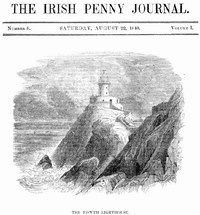
The bold and nearly insulated promontory called the Hill of Howth, which forms the north-eastern terminus of the Bay of Dublin, would in itself supply abundant materials for a topographical volume--and a most interesting work it might be made. For the geologist, botanist, and naturalist, it has an abundant store of attractions, while its various ancient monuments of every class and age, from the regal fortress, the sepulchral cairn, and the cromleac of Pagan times, to the early Christian oratory, the abbey and the baronial hall of later years, would supply an equally ample stock of materials for the antiquary and the historian. With all, or most of these features, we propose to make our readers somewhat familiar in our future numbers; but our present purpose is only to give some account of one of its most recently erected structures--the singularly picturesque and beautiful lighthouse, which we have attempted to depict in our prefixed illustration.
The Baily lighthouse, as it is popularly called, is situated at the eastern extremity of Howth, on a nearly perpendicular rock, whose vertex is elevated one hundred and ten feet above high-water mark. This rock, which is nearly insulated, is the terminus of a long and narrow peninsula of still higher altitude, which stretches out into the sea from the eastern end of the promontory, and whose cliffs are equally precipitous on both sides, so that the most striking and romantic views of the lighthouse can be had from various points, in some commanding the horizon-bound sea, and in others the Bay of Dublin, with all its delightful sceneries of wooded country and mountain ranges. The view which we have chosen for our illustration is taken from the northern side of this peninsula, that presented from the other side having been already published in several popular works; but we trust that this view will not be deemed less striking or picturesque; and we are of opinion that a more romantic subject of its kind is not to be found in the empire.
The lighthouse is itself an object of great interest and beauty, and is constructed according to the most approved models of modern times. Its form is that of a frustrated cone, supporting a lantern which exhibits a fixed bright light. The illumination, according to the system now generally adopted by the Trinity-house, is produced by a set of reflectors ground to the parabolic form, in the foci of which twenty large oil lamps are placed: an outer gallery, lightly but securely railed, surrounds the dome. Connected with the building on its east side, there is a large room, which opens by folding doors on a platform, and where an excellent telescope is kept, by means of which the shoals which obstruct the entrance to the bay may be distinctly observed--namely, the great Kish, and the Bennet and Burford banks, which are links of the chain extending along the Wicklow and Wexford coasts, and called the Irish grounds. These, though not visible, are distinctly marked in stormy weather by the surf, which breaks over them with uncommon violence, and form a dangerous obstruction to the approach to the bay.
The Baily lighthouse was erected by the Ballast Board of Dublin in 1814, previous to which time the Howth light, as it was commonly called, stood on a hill considerably more to the north, and at an elevation of more than three hundred feet above sea level. This circumstance of its great elevation, led, however, to its being abandoned, and the erection of the Baily lighthouse in its place, as it was found to be frequently involved in clouds and mist, while lower stations were clear and well defined.
The Baily lighthouse is a spot of no less antiquarian than picturesque interest. Its name, which is cognate with the Latin ballium, is derived from an ancient circular stone fortress which encircled the apex of the rock, and of which considerable remains existed previous to the erection of the present buildings. This great keep was fortified by three earthen walls, with deep intervening ditches placed at the entrance to the narrow peninsula, and by extending from one side of it to the other, cut it off completely from the promontory. These works still remain, though in a very ruinous state; yet they are sufficiently distinct to mark their purpose, and to convey a good idea of the style of military defensive works in use in extremely remote times. They will be found marked on the Ordnance map.
In the popular traditions of Howth, these works--like most others in Ireland, the real origin of which has been forgotten--are ascribed to the Danes, a remnant of whom, after the battle of Clontarf in 1014, were supposed to have fortified themselves in this peninsula, till they were carried off in their vessels. But such tradition is wholly opposed to history, and the works themselves exhibit sufficient evidences of its fallacy; they belong to a much earlier age, being nothing less than the remains of Dun-Criomthan (pronounced Dun-Criffan), the fortress of Criomthan Nia-nair, who, according to our ancient histories, ascended the throne of Ireland in the year 74, and who, after being dethroned, died in this fastness in the year 90, after a reign of sixteen years. His sepulchral cairn--crowning the summit of Sliabh-Martin, the highest pinnacle of the ancient Bin-edair--is still to be seen.
A century or two more will wholly obliterate these remains of the once powerful prince and warrior Criomthan; but his celebrity belongs to history, and will not thus pass away. It was in the third year of his reign that Agricola fortified the bounds of the Roman empire in Britain from the incursions of the Picts and Irish, the latter, it is said, led by the monarch Criomthan himself, who, according to our annalist, returned to Ireland, loaded with spoil, as thus stated in the record of his death in the Annals of the Four Masters:--
“Criomthan Nia-nair, sixteen years monarch of Ireland, died, after his illustrious foreign expedition. It was from that expedition he brought home the noble spoils; the golden chariot, the golden chess-board studded with three hundred sparkling gems, and the ceth-criomthan, which was a parti-coloured shirt, interwoven with gold. He also brought with him a battle-giving sword, having various figures of serpents engraved upon it, and inlaid with gold; a shield embossed with bright silver; a spear which gave an incurable wound; a sling from which no erring cast could be thrown; two hounds linked together by a chain of silver; together with many other valuable rarities.”
How long after this period Dun-Criomthan existed as a fortress, it would perhaps be impossible now to ascertain, but from the following record in the Annals above quoted, it would appear to have been preserved at least for six centuries:--
“A. C. 646. The battle of Dun-Criomthan was gained by Conall and Kellach (co-monarchs of Ireland), the two sons of Maolcobha, over Aongus, the son of Donall. Aongus was killed in this battle, as was also Cathasach, the son of Donall, his brother.”
These notices, which have not hitherto appeared in an English form, of a highly interesting historical remain, not previously identified by the antiquarian topographer, will, it is hoped, impart a new interest to the Baily of Howth; but, independently of such claims on our attention, its singular picturesqueness should have made it long since not only more familiarly known to the visitors of our capital, but also to ourselves.
P.
JOHNNY HALFACRE; OR, THE VALUE OF TIME.
BY MARTIN DOYLE.
Statesmen and professional men, whether occupying stations of eminence, or struggling to attain them, duly estimate the importance of time; they know the value of an hour too well to mis-spend it. The lawyer of high practice, during the term season, steadily pursuing his laborious studies, and determined to overcome every difficulty in his pursuit of professional rank and wealth, rises early, and borrows from the night so many of those hours which are spent in rest and sleep by men of less mental activity, that he leaves himself but a very contracted measure of time for those essential purposes. As to dining out with friends at this period of care and labour, he rarely ventures to indulge in such a recreation; or if he does on some very particular occasion, such is the discipline of his mind, such the strength of his self-denying habits, that he can rise from the table at a prescribed moment, and with a cool lawyer-like head apply to his nocturnal labours as if there had been no interruption of an exciting nature.
The physician--I do not mean him who is regularly called out of church, or from the social party, by his servant, under the pretence of a pressing call, but the real and laborious practitioner, to whom minutes are money and fame--will not idle away an hour; neither will the sober steady shopkeeper, until he has realized an independence, absent himself from his counter as long as there is a reasonable chance of a customer dropping in; nor the operative mechanic, who has to finish his piece of work within a prescribed time, and who will contrive to do it even in despite of all the petty interruptions to which he is liable.
Time is proportionably valuable to the meanest peasant who possesses a cabbage garden, and if properly estimated and applied, will add to his comforts in a degree of which, he who is habitually uncalculating and unthrifty in this respect can have but little notion.
This I am anxious to impress upon the class of labourers, many of whom I hope can read what I write, for in them I take an especial interest, probably because they are the least cared for of any class in the community. Some of them perhaps will say, with a show of reality, “If our time were to bring us in such profits as the counsellor and the doctor make, we would be busy too, and no one would see us standing idle, sitting on a ditch side, or smoking and coshering by the fireside, or talking to the neighbours, of a wet day, in a forge. If we could be coining guineas as easily as the likes of them makes the money, sitting in their soft chairs, and never doing a hand’s turn of work that would tire their limbs, we would; but what could we make, after our regular day’s work, if we can get that same, out of a bit of a garden, that would better us any thing to signify?”
Now, I shall show them by actual facts what they could in many cases do.
Johnny Halfacre is a little farmer, whom I occasionally see, and who, being in no way connected with me, nor even conscious that I am particularly observing him, goes on in his own way, without any hint or encouragement from me, or indeed from any one else, as far as I can perceive.
Johnny two years ago had not as much land as would correspond with his name, which is really genuine; he had for several previous years but a rood, including the site of his house, and a shed for a pig, and some poultry; but this rood produced more than half an acre usually does with many, and entirely by his good management and judicious application of time.