THE IRISH PENNY JOURNAL.
NUMBER 2. SATURDAY, JULY 11, 1840. VOLUME I.
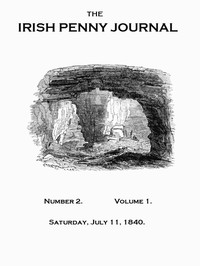
THE CAVES OF KISH-CORRAN.
Among the many wonders of Ireland, as yet undescribed and little known, even to Irishmen, beyond their immediate localities, the subject of our prefixed illustration has every claim to find a place, and to attract our attention as a subject equally interesting to the geologist, artist, and historian. That it should have hitherto remained unnoticed, as we think it has, while objects of the same description in other localities less remarkable and interesting have been repeatedly described, may be attributed chiefly to the circumstance of its situation being remote from any leading road, and in a wild and rarely visited district of country, namely, the barony of Corran, in the county of Sligo. Of this barony, the mountain called Ceis or Kish-Corran, is the most striking geographical feature. It is composed of tabular limestone; has a flat outline at top, but is precipitous on its sides, and rises to an altitude of upwards of a thousand feet. To the traveller journeying from Boyle to Sligo it must be a familiar and pleasing object, as, after passing the little town of Ballinafad, it offers, for some miles of the road towards the west and south-west, the charms of a mountain boundary in contrast to the rich woods of Hollybrook, and the delightful vistas of the water of Lough Arrow, or Arva, which skirt the road along the east. But the most precipitous and noble point of Kish-Corran is presented to the west, and is not seen by the traveller on this road, which must for a time be abandoned to enable him to see it, as well as the wonderful caves which open on its face, and to which we have now to call the attention of our readers. On this western side, the mountain, to within a hundred feet or two of its summit, presents a green but boldly sloping grassy face, formed of the debris of the rocks above, which rise perpendicularly, and look more like a wall--lichen-stained and ivy-decked--formed by the Cyclops or giants of old, than creations of nature's hand. And such impression is increased in no small degree by the lofty and magnificent caves, which present themselves like doorways, and lead into the inmost recesses of the mountain. It is of one of these entrances, and the most remarkable for grandeur, that our illustration attempts to give an idea. Its height is no less than twenty feet. How far the caves extend, we are unable to speak with certainty; they are undoubtedly of great extent, and, if the local accounts are to be trusted, reach even to the opposite or eastern side of the mountain, and contain lakes of unfathomable depth, and spars of unimaginable beauty.
A spot so striking to the imagination could not be, in Ireland, without its legends of a romantic and singular character; and some of these are of a most remote antiquity, and connected with the earliest legendary history of our country. In the ancient topographical tract called the Dinnseanchus, which gives the origin, according to the poets, of the names of the most remarkable mountains, lakes, rivers, caves, forts, &c. in Ireland, we are told that Corran received its name from the harper of Diancecht, to whom that magical race, called the Tuátha de Danann, gave the territory as a reward for his musical skill; and popular tradition still points to the cave of Kish-Corran as his residence, according to the ancient form quoted in the Dinnseanchus:--
"Here used to dwell the gentle Corann, whose hand was skilled in playing on the harp; Corann was the only ollave of Drancich (with whom he lived), in free and peaceable security.
To Corann of the soft music, the Tuátha De gave with great honour a free territory for his skilful playing, his knowledge, and his astrology. Here was he, this generous man, not without literature or in a churlish fortress, but in a place where the stranger was at liberty to a free sojournment with him, this liberal prosperous man."
The same authority accounts for the prefix Ceis, or, as it is pronounced, Kish, which is applied to the mountain by a very singular legend, according to which it would appear that it was originally the name of a lady, who with five others were, by a charm compounded with the nut-fruit, metamorphosed into pigs, the unhappy Ceis herself being here subsequently slain. However this may be, there is nothing improbable in the supposition that the caves of Kish-Corran were in former times the favourite dens of the wild boar, the wolf, and many other animals now extinct; they furnish a secure retreat to the fox and many other wild animals at the present day.
P.
ON BENEVOLENCE OF CHARACTER.
BY MARTIN DOYLE.
If it be afflictive, on one side, to reflect upon the deeds of cruelty and oppression which prevail upon earth, through the instrumentality of man, it is delightful, on the other, to perceive that human reason, instead of being abused and perverted into a source of tyrannical oppression, is occasionally exercised, as it ought to be, in promoting happiness and social harmony, even among brutes; in producing that degree of peaceful concord, which it has been proved may exist among animals whose natural antipathies are the most violent imaginable--that feeling which disarms the strong among them of all desire to tyrannise over and destroy the weak, and is brought into exercise by a steady and persevering system of early training (and consequent acquirement of abiding habits), directly opposed to that which prompts us to place a whip in the hand of a child.
I have been led into this train of contemplation, from having recently witnessed a practical illustration of the wonderful effects producible by what may fairly be termed a benevolent system, for there is no degree whatever of harsh discipline connected with it--no starvation, no blows, nothing of that "reign of terror," under the influence of which Van Amburgh has doubtless effected his dominion over the most ferocious of beasts; the exhibition of which power, while it surprises, does not please us; for, though, by an effort of the imagination, the mind may be led for a moment to the anticipation of the scene in which "the wolf shall dwell with the lamb, and the leopard shall lie down with the kid," it quickly considers this surprising display of human power with painful sensations, from the conviction that extreme severity of discipline alone has enabled man in this instance to attain his despotic sovereignty, and that the unnatural results which he beholds are an evidence that the legitimate dominion granted to man "over every thing that moveth upon the earth," has in this case, as in ten thousand others, been overstrained and abused.
While animals of prey are in a state of nature, they either avoid each other, or meet in deadly contest, according to the degree of their antipathies; and until He who has impressed their dispositions upon them shall bid them lie down together in peace, no efforts of puny man can avail in changing their habits, except under such rare circumstances as confirm the general law of instinct which leads them to destroy each other. But the dislike which many of the domesticated animals entertain for each other, is greatly increased by the encouragement which they receive from man. The dog, which under other treatment would be familiar with the cat or the hog, is taught from his puppyhood to pursue and worry each of them; the cat instinctively defends herself with those claws which are her natural weapons, and she scratches her opponent's face, and through their after life they are never thoroughly reconciled to each other, but live proverbially as "cat and dog." The hog cannot defend himself from the teeth of the dog; his ears are torn by them; he cannot retaliate, but he lives ever afterwards in dread of the whole canine race. Dogs, which otherwise would live in harmony together, are taught to fight; their natural jealousy is encouraged, and they are rendered bullies by profession.
That the dread of man is in a certain degree naturally upon every beast of the field and bird of the air, cannot be disputed; but this feeling is increased considerably by the experience which many brutes have of man's caprice or tyranny, and this dread is transmissible (as may be justly inferred from cases which are perfectly analogous, such as the acquired habit of pointing at game) to their posterity.
A benevolent man, living, as we read of Robinson Crusoe, among his goats, ceases to be an object of apprehension to the animals around him; even birds, habituated to his kindness and protection, would become divested of the dread of man; and each successive generation of those familiarized birds would probably become more and more disposed to associate with him, if he were systematically kind and encouraging in his manner. Such experiments with the brute kind, it is true, can be but extremely partial, and are unattended with any very practically useful results in themselves; but, as respects the education of children, they are of extreme utility in exciting tender and benevolent feelings, and awakening the intellectual faculties from subjects merely sensual or idly amusing; they teach us "to look from Nature up to Nature's God."
There never was a better founded observation than that of the late Mr Cobbett, that no one should be entrusted with the care of the nobler animals who had not been habituated to treat the lesser ones with kindness.
I love to see a child feeding his rabbits or pigeons, and familiarly playing with them, consulting their tastes, and contributing to their comforts by every means within his power. Surely such a pursuit should not be rudely discouraged; how much more humanizing than the desire to possess "whips for a penny," to which I have recently adverted! It tends to render a child compassionate in his disposition to all God's creatures, and unwilling to hurt, for the sake of inflicting pain, or from thoughtless mischief.
And I am just enough of phrenologist to be of opinion that, if there be any remarkable developement of the organ of destructiveness, this may be sufficiently counteracted by the exercise of feelings which have connection with the faculty of benevolence, and so modified, by avoiding all pursuits of a cruel nature, as to constitute, with God's blessing, a benevolent character, which, by the indulgence of the inherent inclination to cruel sports, would become of the opposite nature; for there is unquestionably an adaptation of the mind, as well as the body, to the circumstances under which individuals are placed. It is with the faculties of the human mind as with the habits of brutes; when exercised, they acquire strength, and gradually become more developed and confirmed; ay, and become hereditary too in proportion to their original or gradually progressing degree of developement. How important, then, that the higher faculties, on which depends the elevation of the moral character, should be strengthened by use and exercise! But I have digressed far from the illustration which I was about to give at the beginning, of a practically benevolent system of brute education.