A Room with a View
by E. M. Forster




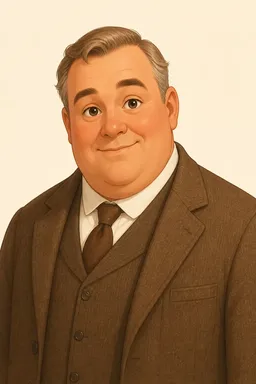


She looked at the books again—black, brown, and that acrid theological blue. They surrounded the visitors on every side; they were piled on the tables, they pressed against the very ceiling. To Lucy who could not see that Mr. Emerson was profoundly religious, and differed from Mr. Beebe chiefly by his acknowledgment of passion—it seemed dreadful that the old man should crawl into such a sanctum, when he was unhappy, and be dependent on the bounty of a clergyman.
More certain than ever that she was tired, he offered her his chair.
“No, please sit still. I think I will sit in the carriage.”
“Miss Honeychurch, you do sound tired.”
“Not a bit,” said Lucy, with trembling lips.
“But you are, and there’s a look of George about you. And what were you saying about going abroad?”
She was silent.
“Greece”—and she saw that he was thinking the word over—“Greece; but you were to be married this year, I thought.”
“Not till January, it wasn’t,” said Lucy, clasping her hands. Would she tell an actual lie when it came to the point?
“I suppose that Mr. Vyse is going with you. I hope—it isn’t because George spoke that you are both going?”
“No.”
“I hope that you will enjoy Greece with Mr. Vyse.”
“Thank you.”
At that moment Mr. Beebe came back from church. His cassock was covered with rain. “That’s all right,” he said kindly. “I counted on you two keeping each other company. It’s pouring again. The entire congregation, which consists of your cousin, your mother, and my mother, stands waiting in the church, till the carriage fetches it. Did Powell go round?”
“I think so; I’ll see.”
“No—of course, I’ll see. How are the Miss Alans?”
“Very well, thank you.”
“Did you tell Mr. Emerson about Greece?”
“I—I did.”
“Don’t you think it very plucky of her, Mr. Emerson, to undertake the two Miss Alans? Now, Miss Honeychurch, go back—keep warm. I think three is such a courageous number to go travelling.” And he hurried off to the stables.
“He is not going,” she said hoarsely. “I made a slip. Mr. Vyse does stop behind in England.”
Somehow it was impossible to cheat this old man. To George, to Cecil, she would have lied again; but he seemed so near the end of things, so dignified in his approach to the gulf, of which he gave one account, and the books that surrounded him another, so mild to the rough paths that he had traversed, that the true chivalry—not the worn-out chivalry of sex, but the true chivalry that all the young may show to all the old—awoke in her, and, at whatever risk, she told him that Cecil was not her companion to Greece. And she spoke so seriously that the risk became a certainty, and he, lifting his eyes, said: “You are leaving him? You are leaving the man you love?”
“I—I had to.”
“Why, Miss Honeychurch, why?”
Terror came over her, and she lied again. She made the long, convincing speech that she had made to Mr. Beebe, and intended to make to the world when she announced that her engagement was no more. He heard her in silence, and then said: “My dear, I am worried about you. It seems to me”—dreamily; she was not alarmed—“that you are in a muddle.”
She shook her head.
“Take an old man’s word; there’s nothing worse than a muddle in all the world. It is easy to face Death and Fate, and the things that sound so dreadful. It is on my muddles that I look back with horror—on the things that I might have avoided. We can help one another but little. I used to think I could teach young people the whole of life, but I know better now, and all my teaching of George has come down to this: beware of muddle. Do you remember in that church, when you pretended to be annoyed with me and weren’t? Do you remember before, when you refused the room with the view? Those were muddles—little, but ominous—and I am fearing that you are in one now.” She was silent. “Don’t trust me, Miss Honeychurch. Though life is very glorious, it is difficult.” She was still silent. “‘Life’ wrote a friend of mine, ‘is a public performance on the violin, in which you must learn the instrument as you go along.’ I think he puts it well. Man has to pick up the use of his functions as he goes along—especially the function of Love.” Then he burst out excitedly; “That’s it; that’s what I mean. You love George!” And after his long preamble, the three words burst against Lucy like waves from the open sea.
“But you do,” he went on, not waiting for contradiction. “You love the boy body and soul, plainly, directly, as he loves you, and no other word expresses it. You won’t marry the other man for his sake.”
“How dare you!” gasped Lucy, with the roaring of waters in her ears. “Oh, how like a man!—I mean, to suppose that a woman is always thinking about a man.”
“But you are.”
She summoned physical disgust.
“You’re shocked, but I mean to shock you. It’s the only hope at times. I can reach you no other way. You must marry, or your life will be wasted. You have gone too far to retreat. I have no time for the tenderness, and the comradeship, and the poetry, and the things that really matter, and for which you marry. I know that, with George, you will find them, and that you love him. Then be his wife. He is already part of you. Though you fly to Greece, and never see him again, or forget his very name, George will work in your thoughts till you die. It isn’t possible to love and to part. You will wish that it was. You can transmute love, ignore it, muddle it, but you can never pull it out of you. I know by experience that the poets are right: love is eternal.”
Lucy began to cry with anger, and though her anger passed away soon, her tears remained.
“I only wish poets would say this, too: love is of the body; not the body, but of the body. Ah! the misery that would be saved if we confessed that! Ah! for a little directness to liberate the soul! Your soul, dear Lucy! I hate the word now, because of all the cant with which superstition has wrapped it round. But we have souls. I cannot say how they came nor whither they go, but we have them, and I see you ruining yours. I cannot bear it. It is again the darkness creeping in; it is hell.” Then he checked himself. “What nonsense I have talked—how abstract and remote! And I have made you cry! Dear girl, forgive my prosiness; marry my boy. When I think what life is, and how seldom love is answered by love—Marry him; it is one of the moments for which the world was made.”
She could not understand him; the words were indeed remote. Yet as he spoke the darkness was withdrawn, veil after veil, and she saw to the bottom of her soul.
“Then, Lucy—”
“You’ve frightened me,” she moaned. “Cecil—Mr. Beebe—the ticket’s bought—everything.” She fell sobbing into the chair. “I’m caught in the tangle. I must suffer and grow old away from him. I cannot break the whole of life for his sake. They trusted me.”
A carriage drew up at the front-door.
“Give George my love—once only. Tell him ‘muddle.’” Then she arranged her veil, while the tears poured over her cheeks inside.
“Lucy—”
“No—they are in the hall—oh, please not, Mr. Emerson—they trust me—”
“But why should they, when you have deceived them?”
Mr. Beebe opened the door, saying: “Here’s my mother.”
“You’re not worthy of their trust.”
“What’s that?” said Mr. Beebe sharply.
“I was saying, why should you trust her when she deceived you?”
“One minute, mother.” He came in and shut the door.
“I don’t follow you, Mr. Emerson. To whom do you refer? Trust whom?”
“I mean she has pretended to you that she did not love George. They have loved one another all along.”
Mr. Beebe looked at the sobbing girl. He was very quiet, and his white face, with its ruddy whiskers, seemed suddenly inhuman. A long black column, he stood and awaited her reply.
“I shall never marry him,” quavered Lucy.
A look of contempt came over him, and he said, “Why not?”
“Mr. Beebe—I have misled you—I have misled myself—”
“Oh, rubbish, Miss Honeychurch!”
“It is not rubbish!” said the old man hotly. “It’s the part of people that you don’t understand.”
Mr. Beebe laid his hand on the old man’s shoulder pleasantly.
“Lucy! Lucy!” called voices from the carriage.
“Mr. Beebe, could you help me?”
He looked amazed at the request, and said in a low, stern voice: “I am more grieved than I can possibly express. It is lamentable, lamentable—incredible.”
“What’s wrong with the boy?” fired up the other again.
“Nothing, Mr. Emerson, except that he no longer interests me. Marry George, Miss Honeychurch. He will do admirably.”
He walked out and left them. They heard him guiding his mother up-stairs.
“Lucy!” the voices called.
She turned to Mr. Emerson in despair. But his face revived her. It was the face of a saint who understood.
“Now it is all dark. Now Beauty and Passion seem never to have existed. I know. But remember the mountains over Florence and the view. Ah, dear, if I were George, and gave you one kiss, it would make you brave. You have to go cold into a battle that needs warmth, out into the muddle that you have made yourself; and your mother and all your friends will despise you, oh, my darling, and rightly, if it is ever right to despise. George still dark, all the tussle and the misery without a word from him. Am I justified?” Into his own eyes tears came. “Yes, for we fight for more than Love or Pleasure; there is Truth. Truth counts, Truth does count.”
“You kiss me,” said the girl. “You kiss me. I will try.”
He gave her a sense of deities reconciled, a feeling that, in gaining the man she loved, she would gain something for the whole world. Throughout the squalor of her homeward drive—she spoke at once—his salutation remained. He had robbed the body of its taint, the world’s taunts of their sting; he had shown her the holiness of direct desire. She “never exactly understood,” she would say in after years, “how he managed to strengthen her. It was as if he had made her see the whole of everything at once.”
The End of the Middle Ages
The Miss Alans did go to Greece, but they went by themselves. They alone of this little company will double Malea and plough the waters of the Saronic gulf. They alone will visit Athens and Delphi, and either shrine of intellectual song—that upon the Acropolis, encircled by blue seas; that under Parnassus, where the eagles build and the bronze charioteer drives undismayed towards infinity. Trembling, anxious, cumbered with much digestive bread, they did proceed to Constantinople, they did go round the world. The rest of us must be contented with a fair, but a less arduous, goal. Italiam petimus: we return to the Pension Bertolini.
George said it was his old room.
“No, it isn’t,” said Lucy; “because it is the room I had, and I had your father’s room. I forget why; Charlotte made me, for some reason.”
He knelt on the tiled floor, and laid his face in her lap.
“George, you baby, get up.”
“Why shouldn’t I be a baby?” murmured George.
Unable to answer this question, she put down his sock, which she was trying to mend, and gazed out through the window. It was evening and again the spring.
“Oh, bother Charlotte,” she said thoughtfully. “What can such people be made of?”
“Same stuff as parsons are made of.”
“Nonsense!”
“Quite right. It is nonsense.”
“Now you get up off the cold floor, or you’ll be starting rheumatism next, and you stop laughing and being so silly.”
“Why shouldn’t I laugh?” he asked, pinning her with his elbows, and advancing his face to hers. “What’s there to cry at? Kiss me here.” He indicated the spot where a kiss would be welcome.
The book keeps going
Keep reading, and see it illustrated
Reading is free forever. Sign up and watch scenes appear while you read.
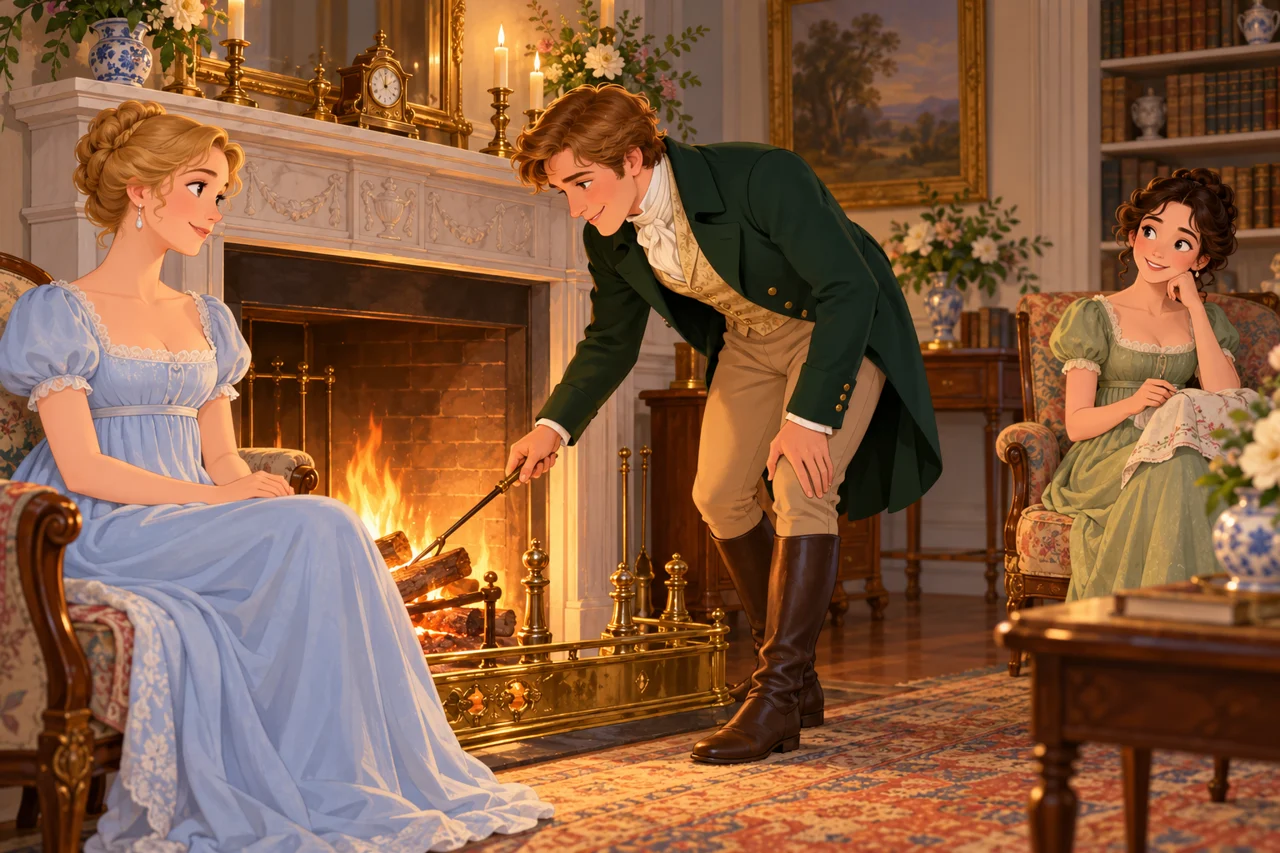
Scenes Storieta drew for other classics.
About this book
A Room with a View is a humorous English novel of manners set partly among British travelers in Florence. Lucy Honeychurch and her cousin Charlotte arrive at the Pension Bertolini hoping for rooms overlooking the Arno, but find instead a crowded, unmistakably English atmosphere that seems almost like London abroad. A disagreement over rooms brings them into contact with the outspoken Mr. Emerson and his son George, while the genial clergyman Mr. Beebe and an eager chorus of fellow tourists offer advice about seeing Italy. Beneath the comic fuss over food, etiquette, accents, and sightseeing lies a more searching interest in how people behave when travel unsettles their habits and expectations.
Forster’s prose is observant, elegant, and lightly satirical, with lively dialogue and a narrator alert to the gap between genteel manners and genuine feeling. The social comedy depends on small gestures, evasions, embarrassments, and the revealing judgments of respectable English visitors. Its early-twentieth-century setting and polished period style will appeal to readers who enjoy character-driven fiction, wry examinations of class and propriety, and travel writing that finds both comedy and tension in the encounter between British convention and Italy.
Shelved under Italy, Romance, Humorous stories, England
Also illustrated
Explore more illustrated classics.
Open any of them and start reading the same way.