Public-domain ebook
The Irish Penny Journal, Vol. 1 No. 05, August 1, 1840
by Various
Language: en242 downloads on Project Gutenberg
Subjects
In: The Irish Penny Journal·Poetry·Humour
Public-domain ebook sourced from Project Gutenberg #52794.
Public-domain ebook
by Various
Language: en242 downloads on Project Gutenberg
Subjects
In: The Irish Penny Journal·Poetry·Humour
Public-domain ebook sourced from Project Gutenberg #52794.
The opening · free to read
THE IRISH PENNY JOURNAL.
NUMBER 5. SATURDAY, AUGUST 1, 1840. VOLUME I.
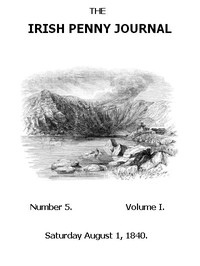
If the citizens of our capital have to acknowledge, and perhaps lament, that they are unable to compete with some other cities of the empire in the extent of their commerce, the number of their manufactories, the wealth of their resident aristocracy, or, in short, any of the various results which a long and uninterrupted course of artificial prosperity is certain to bestow, they may still console themselves with the reflection, that in the singularly varied beauties of scenery with which their city is surrounded they possess riches of greater value, and enjoyments of a higher nature, of which they cannot be deprived by any circumstance, and in which no other city can ever hope to rival them. And although to the mere grovelling pursuer of gain, who is incapable of a single elevated or ennobling feeling, such a consideration may seem a matter of trivial importance, to those of wiser, better, and more happily constituted minds, it will always be a source of self-gratulation, as affording pleasures easily procured, and which they would not exchange for any of a grosser kind. It is, indeed, beyond a question, that there is no city in the British empire exhibiting around it such a variety of picturesque beauties as our own dear Dublin. We have the villa-studded, pastoral plain--the spacious bay, with all its variety of coast, from the sandy beach to the bluff sea-promontory--the richly-wooded valley with its limpid river--the lonely mountain glen with its cataracts and tiny trout-streams--the purple heath and the solitary tarn, or pool--the rural village and the gay watering-place; while in addition to all these, the interest imparted to natural scenery, by remains of ancient times, is every where present. In short, there is no class of scenery which the poet, the painter, the geologist, the botanist, or the mere man of pleasure, could desire, that may not be reached in a drive of an hour or two from any part of our city. Nature has showered on us, with a generous hand, her various riches--the riches derived from her and our Creator. It must, however, be confessed that, as yet, we have not learned sufficiently to appreciate these gifts, and, consequently, do not sufficiently enjoy them. "The world is too much with us"--and there are many scenes of striking interest within our reach, which are more frequently seen by the stranger visitant than by ourselves. Of these, one of the most remarkable is the mountain lake called Lough Bray, of which we give a sketch in our present number. How many thousands are there of the citizens of Dublin who have never seen, perhaps never heard of, this little mountain pool; and yet it is one of the most perfect examples of scenery of its kind in Ireland--one of those spots in which nature appears in her most stern and rugged aspect; solitary, gloomy, and unfit for the companionship of man. Still it is not wholly a desert. The eagles which build in its cliffs have seen a man of a kindred lofty spirit--an eagle among men--build himself a nest amongst these solitudes; and they have been often startled from their eyry by the sounds of aristocratic joy and merriment, when the shores of the dark lake have been enlivened by the presence of the most distinguished in beauty and rank in Ireland.
It is perhaps of all situations a spot in which we should least expect to find a gentleman's villa; yet this innovation is not materially injurious to the prevailing sentiment of the scene. The house is in the Old English style of architecture, highly picturesque, and in all respects worthy of the refined taste of the late Mr William Morrison, the distinguished architect by whom it was erected, and whose early death was an event which may justly be regarded in the light of a national loss. It was erected for Sir Philip Crampton, at the expense of his Grace the Duke of Northumberland, who, while Viceroy of Ireland, had spent some happy days with Sir Philip in this romantic spot, in a cottage of humbler pretensions, which had occupied its site, and was accidentally burned. The gift was one equally worthy of the illustrious donor, and the talented and estimable receiver; and there are few if any of our readers who will not join us in the wish that he may long live to enjoy it.
Lough Bray is situated near the head of the beautiful vale called Glen Cree, in the county of Wicklow, into which it sends a stream, which, subsequently uniting with the Glenisloreane river, is called the Dargle and Bray river, and falls into the sea to the north of Bray Head. Though the name is generally used in the singular number, Lough Bray properly consists of two lakes, called Upper and Lower; but the lower is the principal one, both in point of beauty and grandeur of scenery, as well as in extent of surface, its area occupying a space of thirty-seven acres. It is nearly surrounded by mountain precipices, in which eagles are wont to build, and has very much the character of the crater of an extinct volcano.
Lough Bray is most easily visited from Dublin by the Military Road, by which route the distance is little more than ten Irish miles. P.
THE SOD PARTY.
Of all the pleasant interludes in the drama of life, a sod party, where every thing goes right, is one of the pleasantest. What talking! what fuss! what discussions! what direfully important arrangements for a week before-hand! what a puzzle how to divide the various necessaries into such relatively fair proportions that no individual should feel more burdened than another. I do not mean one of those parties where all the trouble and expense fall upon one unfortunate individual, who, consequently, can derive no pleasure from the affair, except that of seeing others enjoying themselves--a very great pleasure, doubtless, considered abstractedly, but rather too refined for every-day mortals--no; but a regular pic-nic, where lots are drawn, and each supplies whatever may be written on the slip that she or he holds, and furnishes a quota of the trouble, as well as of the provisions; one individual, nevertheless, being the director.
What a hurry-skurry on the morning of the eventful day! Then the assembling of the carriages and other vehicles at the place of rendezvous.
"Dear me," said Mrs Harvey, on the morning of the day appointed for her pic-nic, having consulted her watch for the twentieth time; "dear me, where is Mr Sharpe? What can possibly delay Mrs Molloy? Well, well, how hard it is to get people to be punctual!"
"Oh, mamma, maybe they'll meet us at Howth; we had better set off. If they come here, they can be directed to follow us, you know. Do, pray, mamma, let us move."
"Oh, my dear, we must send a messenger to Mr Sharpe. If he missed us, or took huff at our going without him (and you know he's very tetchy), it would be such a dreadful inconvenience, for he has to supply the knives and forks, spoons and glasses, and he would think nothing of leaving us in the lurch, if he took it into his head; and Mrs Molloy is so forgetful, that she might come without the roast beef, and never think of it until it would be missed at table. George, dear, will you desire John to step over to Mr Sharpe's, and tell him that the company is assembled. And, Mr O'Brien, will you permit me to send your servant to Mrs Molloy with a similar message?"
"Certainly, madam, with the greatest pleasure."
And now the little annoyances inseparable from all sublunary enjoyments, begin.
"John has received a severe hurt, my dear. In packing some bottles, one of them broke, and a piece of it has cut his wrist. I have sent him to the apothecary's to get it dressed."
"Mercy on us! I hope he's not seriously injured. He won't be obliged to stay at home surely?"
"I am afraid he must, my dear."
"If he does, every thing will go wrong, he is such a careful creature, and so completely up to every thing on a sod party, and has every thing so orderly and regular, and all without fuss or hurry. Oh, dear! we shall be sadly off without him."
Mr Sharpe was announced, and a slight, small, dapper little personage made his appearance. A physiognomist of the very least discernment must at once have pronounced him to be a satirical, irritable, genuine lover of mischief, for mischief's sake--mirthful after his own fashion, and as merry as a grig upon a gridiron, when every face about him should be drawn to a half yard in length by some unforeseen annoyance, or petty disaster. He rubbed his hands, congratulating the ladies on the fineness of the day. "Heavenly morning--fine road--Bay of Dublin will be seen to such advantage--sea so smooth--coast of Wicklow splendid--Killiney will look so bold"--talk--talk--talk; he stunned every person with his extraordinary volubility.
Mr O'Brien's servant entered. "Please, ma'am, Mrs Molloy is coming." Scarcely was the message delivered when the lady made her appearance.
"Oh, my dear Mrs Harvey, I hope I hav'nt kept you waiting long. I totally forgot that this was the day appointed for your party, until Sparks reminded me of it by calling me up."
"Make no apologies, my dear madam; we havn't waited at all. Mr Sharpe has but just arrived, and our number is now complete. Have you every thing packed?"
"Packed! Why, do you think we'll have rain?--had I better get my cloak and umbrella? But, sure, I can go in your carriage, and as I shan't be exposed on an outside car, I won't want them."
"My dear Mrs Molloy, it is the beef I allude to. Is it packed?"
"The beef! What beef?"
"Why, dear me, you surely havn't forgotten that a six-rib piece of roast beef was to be supplied by you?"
"I--declare--I--never--once--thought--of it. Well, now, that's very odd."
Mr Sharpe's countenance fell. The discovery had been made too timely to please him.
"What's best to be done now? I can purchase beef somewhere as we go along, and we'll get it dressed at Howth, in some cabin or another."
"Phwee--oo," whistled Mr Robert O'Gorman, "what the deuce would we do with ourselves for five or six hours, at the least, that such a piece would take to roast, without any thing to keep its back warm in an open cabin? I'll tell you what, ma'am: give me the money, and I'll get as much cold roast beef as you like, from Mulholland."
"Who is Mulholland?"
"Oh, 'tis no matter; I'll get the meat, if you want it."
"Very well, Mr O'Gorman, do so, and you'll oblige me; here is a guinea. But why not tell who Mulholland is?"
Mr O'Gorman bolted, without making any reply.
Now, the fact of the matter was simply this, that Mulholland was a sort of second-hand caterer, who purchased the meat that was sent unused from the dining-hall of Trinity College, and supplied it again to such students as felt too economically inclined to attend commons, and thus save money from the parental allowances, for other, and better (?) uses. To this class did Mr O'Gorman sometimes belong.
In a very short time he re-appeared.
"You were not long, Mr O'Gorman; did you succeed in getting a suitable piece?"
"Suitable? If sixteen pounds will suit you, I have got that; and I gave him the change of the guinea," addressing Mrs Molloy, "for himself, ma'am, for his trouble in packing it, and the loan of the basket, which of course he can't expect in reason ever to see again. Nobody would bring home an empty basket."
The book keeps going
Reading is free forever. Sign up and watch scenes appear while you read.



Scenes Storieta drew for other classics.
New illustrated classics
Once or twice a month: the latest books to get full character casts, scene art, and free comic editions. No account needed.