THE IRISH PENNY JOURNAL.
NUMBER 10. SATURDAY, SEPTEMBER 5, 1840. VOLUME I.
The mighty Shannon--the monarch of island rivers--in all its mazy wanderings almost from one extremity of Ireland to the other, presents upon its green and diversified banks but few features of greater natural beauty or historic interest than the point called Rinn-duin--a peninsula which stretches into that great expansion of its waters called Lough Ree, between the counties of Roscommon, Westmeath, and Longford. This peninsula, which is situated upon the Roscommon shore of the lake, about eight miles to the north of Athlone, is nearly a mile in length, and, at its widest part, a quarter of a mile in breadth; but it narrows gradually towards its extremity, and the lake nearly insulates a moiety of it at its centre. Its direction being southerly, the eastern side faces the expanse of the lake, and commands an extensive prospect of its islands and the opposite shores, while its western side, facing the land, forms a beautiful bay, fringed with green sloping declivities.
A spot so circumstanced must have struck the early inhabitants of the country as a sort of natural fortress, which could be easily strengthened by art; and that it was so strengthened and used as a fortress in the remotest historic times, may be inferred from its most ancient Celtic name--Rinn-duin, the point of the Dun or Fort, by which it is still known in the Irish language, though commonly anglicised Randown, and more generally called St John’s. It is mentioned by this name in the following record in the Annals of the Four Masters at the year 1156:--
“There occurred a great fall of snow and a frost in the winter of this year, so that the lakes and rivers of Ireland were frozen over. The frost was so great that Roderick O’Conor was enabled to have his ships and boats carried on the ice from Blein Gaille on the Shannon (at Lough Ree) to RINN-DUIN.”
Of the earlier history of this fort, however, which was doubtless but an earthen one, no accounts are preserved, though it may be safely conjectured that it was seized on and used as a stronghold by the Danish King Turgesius in the ninth century, as it appears certain from our annals that he had a strong fastness and harbour for his ships upon Lough Ree. But, be this as it may, we learn from another record in the Annals above quoted, that Rinn-duin was used as a fastness by the first Anglo-Norman invaders of Ireland as early as the close of the twelfth century, when they were forced to seek safety in it after a defeat which they had sustained in a battle with Cathal Carrach O’Conor, the son of Roderick and King of Connaught. The passage is as follows:--
“A. D. 1199. John de Courcy, at the head of the English of the North, and the son of Hugh de Lacy, at the head of the English of Meath, marched to Kilmacduach to aid Cathal the Red-handed O’Conor. Cathal Carrach, at the head of the Connacians, gave them battle. The English of Ulidia and Meath were defeated with such slaughter, that of their five battalions only two survived, and these were pursued from the field of battle to RINN-DUIN on Lough Ree, in which place John was hemmed in. Many of his English were killed and others drowned, for they had no mode of effecting their escape but by crossing the lake in boats.”
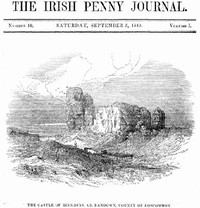
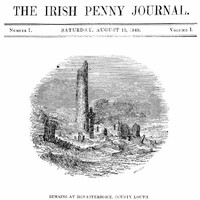
It was not, however, long after this event till the English, taking advantage of the civil wars which raged in Connaught between the sons of Roderick and the sons of Cathal the Red-handed, got the peninsula of Rinn-duin into their own hands, and, fortifying it in their own more skilful manner, erected the noble castle, the ruins of which still remain, and form the subject of our prefixed illustration. The erection of this castle is thus recorded in the Annals of the Four Masters:--
“A.D. 1227. Hugh, the son of Roderick O’Conor, and William de Burgo, marched with a great army to the north of Connaught, burned Inis Meadhoin, plundered the country as they passed along, and took hostages. Geoffry Mares (or de Marisco), and Turlogh, the son of Roderick O’Conor, marched with an army into Magh Aoi (county of Roscommon), erected a castle at RINN-DUIN, and took the hostages of Siol-Muireadhaigh.”
It was at this period also that the lower portion of the peninsula was artificially insulated as an additional protection to the castle, by a broad ditch, still to be seen, though no longer filled with water, and which is connected with a beautiful little harbour for boats, called Safe Harbour, immediately beneath the castle.
But though, as we have shown, the peninsula of Rinn-duin was thus fortified by the English, it was not till the power of the O’Conors was still more broken by their own divisions, that the former were able to keep permanent possession of it. From a subsequent record in the Annals of the Four Masters, we find it shortly after in the possession of Turlogh O’Conor, the son of Roderick, who had been set up by the English in opposition to his cousin and rival Felim, the son of Cathal the Red-handed, and by whom he was ultimately slain. This record gives a curious picture of the mode of warfare of the time, and is worth presenting to our readers in full:--
“A.D. 1236. Felim, the son of Cathal the Red-handed, returned to Connaught after his banishment, being invited thither by some of the Connacians, namely, by O’Kelly, O’Flynn, the son of Hugh, who was son of Cathal the Red-handed O’Conor, and the son of Art O’Melaghlin, all forming four equally strong battalions. They marched to RINN-DUIN, where Brian, the son of Turlogh (O’Conor), Owen O’Heyne, Conor Boy, the son of Turlogh, and Mac Costelloe, had all the cows of the country; and Felim’s people got over the enclosures of the Island; and the leaders and subleaders of the army drove off each a proportionate number of the cows, as they found them on the way before them; and they then dispersed, carrying off their booty in different directions, and leaving only, of the four battalions, four horsemen with Felim. As Brian, the son of Turlogh, Owen O’Heyne, and their troops, perceived that Felim’s army was scattered, they set out quickly and vigorously with a small party of horse, and many foot soldiers, to attack Felim and his few horsemen. Conor Boy, the son of Turlogh, came up with the son of Hugh, who was the son of Cathal the Red-handed, and with his party; and mistaking them for his own people, he fell by Roderick, the son of Hugh, who was the son of Cathal the Red-handed. Felim (the king) strained his voice calling loudly after his army, and ordering them to return to oppose their enemies. Many of the host were killed by Felim upon the island; and outside the island were slain many bad subjects, and perpetrators of evil, as they all were, excepting only Teige, son of Cormac, who was son of Tomaltagh M’Dermott.”
Our records are too scanty to enable us to trace the history of this castle and its various possessors with any clearness or consecutive order. It may, however, be inferred from the subsequent annals that it fell into the hands of Felim O’Conor after the attack above stated, and also that he kept possession of it till his death in 1264. During this period, though harassed by the De Burgos or Burkes, and still more by factious rivals of his own race, he usually preserved at least the semblance of peace with the English monarch, and had more than once his hereditary patrimony of five cantreds of land in Roscommon secured to him by royal charters. Upon one of those occasions the scene of conference between the representatives of the British monarch and the Connaught king was the Castle of Rinn-duin, as thus stated in the Annals of the Four Masters:--
“A. D. 1256. A lord justice arrived in Ireland from England, and he and Hugh O’Conor (the son of Felim) held a conference at RINN-DUIN, when a peace was established between them, on condition that while the lord justice should retain his office, no part of the province of Connaught should be taken from O’Conor.”
By the death of Felim, however, the house of O’Conor received a blow which it never thoroughly recovered; for, though his son Hugh, who succeeded him in the government, inherited to the full extent his father’s energy and valour, if not his prudence, he was less successful in his enterprises, and his death in 1274 gave additional strength to the English interest in Connaught. From a record in the Annals of the Four Masters it appears that the Castle of Rinn-duin was in the possession of the English settlers some years before his death, for it is stated at the year 1270 that
“The castle of Ath-Angaile, the castle of Sliabh-Lugha, and the castle of Cill Calman, were demolished by O’Conor; Roscommon, RINN-DUIN, and Uillin-Uanach, wore also burned by him.”
From this period forward the Castle of Rinn-duin appears to have been permanently garrisoned by the English, and its history can be traced only in the English records. In the great roll of the pipe, 1 Edward I. (1273), among the disbursements of John de Saundford of the escheats and wards of the Lord the King, it is stated that £12 18s was paid to Geoffry de Geneville, chief justice of Ireland, for the re-edification and repairs of the Castle of Rendon; and also that 45 shillings were paid to Master Rico le Charpentier (or the carpenter) for 40 stone and 5 pounds of steel for the construction of a certain mill at the same place. Again, in the account of the expenses of the same Geoffry de Geneville, from Wednesday next after the Assumption of the Virgin, anno 1 Edward I., to Michaelmas, 2 Edward I. (1273 to 1274), the following item occurs:--
“For the Castle of Rendon, to pay for the garrison and other necessaries £439 0 3¼”
So in the account of Robert de Ufford, chief justice of Ireland, of all receipts, expenses, &c., delivered by Adam de Wettenhall into the Exchequer, from Christmas to Michaelmas, 4 Edward I. (1276), among the items are allowances for supplies of victuals for the garrison of Ren-duin, the construction of a mill, and other works of a new construction, the repairing of a fosse there, &c. Again, in the accounts for the following year, 1277, the following item occurs:--
“To Richard de Marisco, for works in the fosse and castle of Rendon £7 10 0”
And in the pipe roll of the 8th Edward I. there are similar accounts of disbursements for repairs to this fortress.
These notices are perhaps of little general interest, but they afford conclusive evidences of the ancient importance of this fastness, and the value set upon its possession as necessary to the support of the English interests in Connaught. The same records preserve the names of three of its constables, viz:--
Walter le Enfant was constable in 1285-87.
Richard Fitz-Simon Fitz-Richar was constable, with the annual fee of £40, in 1326.
John de Funtayns was constable, with the same fee, in 1334.
It appears that during the reigns of the first three Edwards, Rinn-duin became the seat of a town of some importance; and it was also the seat of a parish church and two monastic establishments, of which one was a priory for Knights Hospitallers, or for Cross-bearers, which, according to Ware, was said to have been founded in the reign of King John, and, as some writers say, by his express command. Be this, however, as it may, Philip de Angulo, or Costelloe, was a great benefactor to it in the reign of Henry III., if not actually, as it is probable, its founder.