THE IRISH PENNY JOURNAL.
NUMBER 15. SATURDAY, OCTOBER 10, 1840. VOLUME I.
Localities are no less subject to the capricious mutations of fashion in taste, than dress, music, or any other of the various objects on which it displays its extravagant vagaries. The place which on account of its beauties is at one period the chosen resort of pleased and admiring crowds, at another becomes abandoned and unthought of, as if it were an unsightly desert, unfit for the enjoyment or happiness of civilized man. Some other locality, perhaps of less natural or acquired beauty, becomes the fashion of the day, and after a time gets out of favour in turn, and is neglected for some other novel scene before unthought of or disregarded. Yet the principles of true taste are immutable, and that which is really beautiful is not the less so because it has ceased to attract the multitude, who are generally governed to a far greater extent by accidental associations of ideas than by any abstract feelings of the mind.
Perhaps it is less attributable to any characteristic volatility in the character of the inhabitants of our metropolis, than to the singular variety and number of the beautiful localities which surround our city, and in emulous rivalry attract our attention, that this inconstancy of attachment to any one locality is more strikingly instanced among ourselves, than among the citizens of any other great town with which we are acquainted. But, however this may be, the fact is unquestionable, that there is scarcely a spot of any natural or improved beauty, within a few miles of us, which has not in turn had its day of fashion, and its subsequent period of unmerited neglect. Clontarf, with its sequestered green lanes, and its glorious views of the bay--Glasnevin, the classical abode of Addison, Parnell, Tickell, Sheridan, and Delany--Finglas, with its rural sports--Chapelizod, the residence of the younger Cromwell--Lucan, Leixlip, with their once celebrated spas, and all the delightful epic scenery of the Liffey--Dundrum, with its healthy mountain walks and atmosphere, and many others unnecessary to mention, all experiencing the effects of this inconstancy of fashion, have found their once admired beauties totally disregarded, and the admiration of the multitude almost wholly transferred to a wild and unadorned beauty on the rocky shores of Kingstown and Bullock, which our forefathers deemed unworthy of notice. But let that beauty take warning from the fate of her predecessors, and not hold her head too high in her day of triumph, for she too will assuredly be cast off in turn, and find herself neglected for some rival as yet unnoticed.
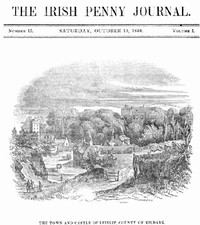
Of such unmerited inconstancy and neglect there are no localities in the neighbourhood of Dublin which have greater reason to complain than the village of Lucan and that which forms the subject of our prefixed embellishment. As the establishment of peace in Ireland led to an increase of civilization, which exhibited itself in improved roads and vehicles of conveyance, and the citizens, emerging from their embattled strongholds, ventured to enjoy the pleasures of nature and rural life, Lucan and Leixlip, with the beautiful scenery in which they are situated, became the favourite places of resort; and their various natural attractions becoming heightened by art, were described by travellers, and chaunted in song. About “sixty years since” they had reached their greatest glory, and Leixlip was the favourite of the day. It is thus described at this period by the celebrated Doctor Campbell:--“All the outlets of Dublin are pleasant, but this is superlatively so which leads through Leixlip, a neat little village about seven miles from Dublin, up the Liffey; whose banks being prettily tufted with wood, and enlivened by gentlemen’s seats, afford a variety of landscapes, beautiful beyond description.” It was at this period also that O’Keefe, in his popular opera of “The Poor Soldier,” makes Patrick sing--
“Though Leixlip is proud of its close shady bowers, Its clear falling waters and murmuring cascades, Its groves of fine myrtle, its beds of sweet flowers, Its lads so well dressed, and its neat pretty maids.”
But though Leixlip no longer holds out attractions sufficient to gratify those whose tastes are dependent on fashion, it has never ceased to be a favourite with all whose tastes had a more solid foundation. It was here, and in its immediate vicinity, that the two Robertses, genuine Irish landscape painters, found many of the most congenial subjects for their pencils. It was here, too, that the strong-headed painter of strong heads--the Rembrandt of miniature painters, John Comerford--used occasionally to retire, abandoning for a week or two the intellectual society of Dublin which he so much enjoyed, and the acquisition of gain which he no less relished, to make some elaborate study of one of the scenes about the Bridge of Leixlip, which he, in his own dogmatic way, asserted, “for genuine landscape beauty, could not be surpassed or even rivalled any where!” This estimate of the beauties of Leixlip’s “close shady bowers, &c.” was, we confess, a somewhat extravagant one; yet, like most other honestly formed opinions of Comerford’s, it would not have been an easy task to shake his belief in its truth, and to sustain it he could, if combated, adduce the testimony of his and our friend Gaspar Gabrielli, the first of Italian landscape painters of our times, who notwithstanding his pride in being a Roman, and his national predilections in favour of the classic scenery of his dear Italy, has often declared in our hearing that he had never seen in his own country scenery of its kind comparable with that of the Liffey, in the vicinity of Lucan and Leixlip.
But enthusiastic admiration of the scenery of Leixlip has not been confined to the painters. Hear with what gusto our friend C. O. lets himself out on this subject, not in his drawing-room character as the clerical Connaught tourist, but in his more natural, buoyant, and Irish one, as Terence O’Toole, our co-labourer in the first volume of the Dublin Penny Journal:--
“Any one passing over the Bridge of Leixlip, must, if his eye is worth a farthing for anything else than helping him to pick his way through the puddle, look up and down with delight while moving over this bridge. To the right, the river winning its noisy turbulent way over its rocky bed, and losing itself afar down amidst embossing woods; to the left, after plunging over the Salmon-leap, whose roar is heard though half a mile off, and forming a junction with the Rye-water, it takes a bend to the east, and washes the rich amphitheatre with which Leixlip is environed. I question much whether any castle, even Warwick itself [bravo, Terence!] stands in a grander position than Leixlip Castle, as it embattles the high and wooded grounds that form the forks of the two rivers. Of the towers, the round one of course was built by King John, the opposite square one by the Geraldines. This noble and grandly circumstanced pile has been in latter days the baronial residence of the White family, and subsequently the residence of [lord-lieutenants] generals and prelates. Here Primate Stone, more a politician than a Christian [churchman], retired from his contest with the Ponsonbys and the Boyles to play at cricket with General Cunningham; here resided Speaker Connolly before he built his splendid mansion at Castletown; here the great commoner, as he was called, Tom Connolly, was born. Like many such edifices, this castle is haunted: character and keeping would be altogether lost if towers of 600 years’ standing, with rich mullioned ‘windows that exclude the light, and passages that lead to nothing,’ with tapestried chambers that have witnessed pranks of revelry and feats of war, of Norman, Cromwellian, and Williamite possession, if such a place had not its legend; and one of Ireland’s wildest geniuses, the eccentric and splendid Maturin, has decorated the subject with the colourings of his vivid fancy.”
Terence adds:--“Leixlip is memorable in an historic point of view as the place where, in the war commencing 1641, General Preston halted when on his way to form a junction with the Marquis of Ormonde to oppose the Parliamentarians. Acknowledging that his army was not excommunication proof, he bowed before the fiat of the Nuncio, and lost the best opportunity that ever offered of saving his cause and his country from what has been called the ‘curse of Cromwell.’”
To this brief but graphic sketch of our friend we can add but little. Leixlip is a market and post town of the county of Kildare, situated in the barony of North _Salt_--a name derived from the Latin appellation of the cataract called the Saltus Salmonis, “Salmon Leap,” in the vicinity of the town--and is about eight miles from Dublin. It contains between eleven and twelve hundred inhabitants, and consists of one long street of houses, well, though irregularly built, but exhibiting for the greater number an appearance of negligence and decay. It is bounded on one extremity by the river Liffey, which is crossed by a bridge of ancient construction, and on the other by the Rye-water, over which there is a bridge of modern date. As the focus of a parish, it has a church and a Roman Catholic chapel, both of ample size and substantial construction, but, like most edifices of their class in Ireland, but little remarkable for the purity of their architectural styles. The latter is of recent erection. Its most imposing architectural feature is, however, its castle, which is magnificently situated on a steep and richly wooded bank over the Liffey; but though of great antiquity, it exhibits in its external character but little of the appearance of an ancient fortress, having been modernised by the Hon. George Cavendish, its present occupier. On its west side it is flanked by a circular, and on its east by a square tower. This castle is supposed to have been erected in the reign of Henry II. by Adam de Hereford, one of the chief followers of Earl Strongbow, from whom he received as a gift the tenement of the Salmon Leap, and other extensive possessions. It is said to have been the occasional residence of Prince John during his governorship of Ireland in the reign of his father; and in recent times it was a favourite retreat of several of the Viceroys, one of whom, Lord Townsend, usually spent the summer here. From an inquisition taken in 1604, it appears that the manor of Leixlip was part of the possessions of the abbey of St Thomas in Dublin. In 1668, the castle, with sixty acres of land, belonged to the Earl of Kildare. They afterwards passed into the hands of the Right Hon. Thomas Connolly, Speaker of the Irish House of Commons, and are now the property of Colonel Connolly of Castletown.
P.
THE CHASE, A POEM TRANSLATED FROM THE IRISH--CONCLUDED.
PATRICK.
O son of kings, adorned with grace, ’Twere music to my ear, Of Fionn and his wondrous chase The promised tale to hear.