THE IRISH PENNY JOURNAL.
NUMBER 24. SATURDAY, DECEMBER 12, 1840. VOLUME I.
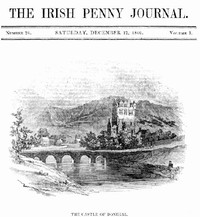
The ruins of the old castellated Mansion of Donegal are not only interesting as affording, to use the words of Sir R. Colt Hoare, “a good subject for the pencil,” but still more as a touching memorial of the fallen fortunes of a long-time powerful and illustrious family, the ancient lords of Tirconnell. These ruins are situated on the north bank of the little river Easky, or the fishy river, at the extremity of the town to which, as well as to the county, it has given its name. This name, however, which signifies literally the Dun, or Fort of the Foreigners, is of much higher antiquity than the castle erected here by the O’Donnells, and was, there can be no doubt, originally applied to a fortress, most probably of earth, raised here by the Danes or Northmen anterior to the twelfth century; for it appears unquestionable that the Irish applied the appellations Gaill exclusively to the northern rovers, anterior to the arrival of the English. Of the early history of this dun or fortress there is nothing preserved beyond the bare fact recorded in the Annals of Ulster, that it was burnt by Murtogh M’Loughlin, the head of the northern Hy-Niall race, in the year 1159. We have, however, an evidence of the connection of the Danes with this locality more than two centuries earlier, in a very valuable poem which we shall at no remote time present to our readers, addressed by the Tirconnellian bard, Flan Mac Lonan, to Aighleann and Cathbar, the brothers of Domhnall, from whom the name of O’Donnell is derived. In this poem, which was composed at the commencement of the tenth century, the poet relates that Egneachan, the father of Donnell, gave his three beautiful daughters, Duibhlin, Bebua, and Bebinn, in marriage to three Danish princes, Caithis, Torges, and Tor, for the purpose of obtaining their friendship, and to secure his territory from their depredations; and these marriages were solemnised at Donegal, where Egneachan then resided.
But though we have therefore evidence that a fort or dun existed here from a very remote time, it would appear certain, from a passage in the Annals of the Four Masters, that a castle, properly so called, was not erected at Donegal by the O’Donnells till the year 1474. In this passage, which records the death of Hugh Roe, the son of Niall Garve O’Donnell, at the year 1505, it is distinctly stated that he was the first that erected a castle at Donegal, that it might serve as a fortress for his descendants; and that he also erected as it would appear, at the same time, a monastery for Observantine Franciscans near the same place, and in which he was interred in the seventy-eighth year of his age, and forty-fourth of his reign. From this period forward the Castle of Donegal became the chief residence of the chiefs of Tirconnell, till their final extinction in the reign of James I., and was the scene of many a petty domestic feud and conflict. From a notice of one of these intestine broils, as recorded in the Annals of the Four Masters, at the year 1564, it would appear that shortly previous to that period a tower, called “the New Tower,” had been added to the older structure. This tower being at that time in the possession of Hugh, the grandson of the builder of the original castle, while the latter was inhabited by his fraternal nephews, Con, the son of Calvarch, then Prince of Tirconnell, in the absence of his father, attempted to get possession of both, and nearly succeeded, when he was made captive by O’Neill.
Towards the close of the great war with the Earl of Tyrone in 1601, this castle, as well as the adjacent monastery, having been placed in the hands of the Queen’s troops, through the instrumentality of Niall Garve O’Donnell, it was besieged and taken by the celebrated leader, Red Hugh O’Donnell, who afterwards blockaded the English in the monastery, from the end of September till the end of October following. But though the besieged were reduced to the utmost extremity, in consequence of the explosion of their powder by some accident, which reduced the greater part of the monastery to ruins, they maintained their position with undaunted bravery, and O’Donnell finally raised the siege, and passed into Munster to join the Spaniards. It appears, however, from a contemporaneous poem, addressed to the ruins of this castle, a translation of which we shall presently lay before our readers, that O’Donnell did not depart from his native territory, never to return, till he had reduced the proud castle of his ancestors to a ruined pile, assigning as a reason, that it should never become what its name indicated--a fortress for strangers!
Whether this castle was subsequently repaired or reconstructed by Red Hugh’s brother Rory, the Earl of Tirconnell, during the few years for which he held his earldom previous to his flight to Rome, does not appear from any document which has fallen under our notice, and we are inclined to believe that he did not do so. But be this as it may, the existing ruins retain no feature of a castle of the 15th century, but on the contrary are in every respect characteristic of the castellated residences of the reign of James I.; so that if it be of Rory O’Donnell’s age, he must have rebuilt the mansion from its foundation. It appears, however, at least equally probable that the present structure may owe its re-erection to Sir Basil Brooke, to whom a grant of the castle was made in 1610. But it is certain, at all events, that he repaired the castle and resided in it until his death in 1633; and two chimney-pieces which still remain are unquestionably of his time, as the arms on one of them testify. These arms, which are sculptured on two shields, are, on the first, those of Brooke impaling Leicester--the family name of Sir Basil’s lady; and on the second, those of Brooke only. These chimney-pieces, which are very splendid specimens of the architectural taste of the age, are faithfully represented in wood-cuts in the second volume of the Dublin Penny Journal, and are accompanied by an excellent notice from the pen, as we believe, of Sir William Betham. In this notice it is stated that the Castle of Donegal “was granted by patent, dated the 16th November 1610, to Captain Basil Brooke, for twenty-one years, if he should live so long, with one hundred acres of land, and the fishings, customs, and duties extending along the river from the castle to the sea. Captain Brooke was knighted 2d February 1616, by Sir Arthur Chichester, knight, Lord Deputy, and had a re-grant of twenty-one years, or his life, of the castle by patent, dated 27th July 1620, and on the 12th February 1623, he had a grant of the fee of the castle for ever.”
According to the same authority, this “Sir Basil Brooke was a scion of the family of Brooke of Norton, in Cheshire, and his lady was Anne, daughter of Thomas Leicester of Toft, in that county. Henry Vaughan Brooke, Esq. Member of Parliament for the county of Donegal, was his descendant and heir-at-law, who left the estates of his family to his nephew Thomas Grove, Esq. who took the name and arms of Brooke by royal sign-manual in 1808. He died without issue, and the estates of the family went to Thomas Young, Esq. of Lough Esk, who also took the name of Brooke by royal sign-manual, dated 16th July 1830, and is the present possessor.”
During the troubles of 1641, the Castle of Donegal was garrisoned for the king by Sir Henry Brooke, the son of Sir Basil; but was taken in May 1651 by the Marquess of Clanricarde, who was joined by the Ulster forces under Sir Phelim O’Neill, when the O’Reillys and the MacMahons joined with him. But the castle was shortly afterwards abandoned by him, on receiving intelligence of the advance of Sir Charles Coote, into whose possession it then fell. Since that period the Castle of Donegal has never we believe been used as a residence, and no care has been taken to save it from the ruined state in which it now appears. It is, however, to the credit of its present possessor that he has taken every care to delay as much as possible the further ravages of time on a structure so interesting in its associations with the past.
It is indeed impossible to look on this venerable pile without carrying our minds back to the days of its proud but unfortunate chiefs; and in our feelings of pity for their fate, indulging such sentiments as one of their last bards has attempted to express in the following poem, addressed to its ruins, and of which we give a literal translation. It is the composition of Malmurry Mac-an-Ward, or the son of the bard, and was written on the demolition of the castle by Red Hugh O'Donnell in 1601.
ADDRESS TO THE RUINS OF DONEGAL CASTLE.
O, solitary fort that standest yonder, What desolation dost thou not reveal! How tarnished is the beauty of thine aspect, Thou mansion of the chaste and gentle melodies!
Demolished lie thy towering battlements-- The dark loam of the earth has risen up Over the whiteness of thy polished stones; And solitude and ruin gird thee round.
Thy end is come, fair fortress, thou art fallen-- Thy magical prestige has been stripped off-- Thy well-shaped corner-stones have been displaced And cast forth to the outside of thy ramparts.
In lieu of thy rich wine feasts, thou hast now Nought but the cold stream from the firmament; It penetrates thee on all sides, Thou mansion like Emania the golden.
Thy doorways are, alas! filled up, Thou fortress of the once bright doors! The limestones of thy top lie at thy base, On all the sides of thy fair walls.
Over the mouldings of thy shattered windows, The music that to-day breaks forth Is the wild music of the birds and winds, The voices of the stormy elements!
O, many-gated Court of Donegal, What spell of slumber overcame thee, Thou mansion of the board of flowing goblets, To make thee undergo this rueful change?
Thou wert, O, happy one of the bright walls, The Fortress of the Meetings of Clann-Connell, The Tara of Assemblies to Conn’s offspring, O, thou resplendent fount of nobleness!
Thou rivalledst Emania in Ulster, Thou wert the peer of Cruachan in Connaught, Or of the mansion over the bright Boyne, Thou Rome of all delight for Erin!
In thee, thou fair, capacious dome, Where Ulster’s tributes prodigally spent, And Connaught’s tributes were poured into thee, Deserted though thou art this night!
From thee have we beheld--delightful sight!-- From the high pinnacles of thy purple turrets, Long lines of ships at the approach of May, With masts and snow-white sails.
From the high pinnacles of thy white watch-towers We have seen the fleetness of the youthful steeds, The bounding of the hounds, the joyous chase, Thou pleasant fastness of unnumbered plains!
Within thee at the festive board We have seen the strong battalions of the Gael, And outside on thy wide green court, After the meeting and the feasting.
Alas for this event, O Dun-na-Gall! Sad is the lethargy that trances thee, It is my grief to see thee thus deserted, Without thy nobles, without mirth to-night!