Public-domain ebook
The Irish Penny Journal, Vol. 1 No. 32, February 6, 1841
by Various
Language: en272 downloads on Project Gutenberg
Subjects
Public-domain ebook sourced from Project Gutenberg #54748.
Public-domain ebook
by Various
Language: en272 downloads on Project Gutenberg
Subjects
Public-domain ebook sourced from Project Gutenberg #54748.
The opening · free to read
THE IRISH PENNY JOURNAL.
NUMBER 32. SATURDAY, FEBRUARY 6, 1841. VOLUME I.
In that fertile district of the county Wexford, the barony of Forth, distinguished for its comfortable cottages and general good husbandry, lived Dennis Costigan, a rich farmer. His farm was large, well stocked, and in high condition; his dwelling-house was furnished as a farmer’s house should be, and it was as cleanly and neat as it was commodious. His wife was tidy, notable, and good-tempered, and his three children were such as would please a father--well-formed in person and virtuous in mind. Then, should not our friend Dennis Costigan have been a happy man? He would have been so _perhaps_--for there is ever to be a stumbling block in our road to happiness--_but_ that the first object that glared upon his eyes in each morning’s sun was the white low cottage of his next neighbour Miles Kavanagh. Yet that cottage was not an ugly feature in the landscape. It was small and low, but as white as the whitest lime could make it; it was neatly thatched too, and its small casements were never broken or patched. A few honeysuckles and roses crept up its walls, and it was surrounded by a hedge of hazels and sallows, that lent it an air of comfort and seclusion. Its owner, at least, thought it a pretty spot, and that he was a happy man indeed to possess it and its two or three adjoining acres; and as he trimmed his hedges, and looked pleasantly on all around--the fruits of his industry and labour--he little thought that any one could look upon his cot and farm with other eyes than those of admiration; and least of all that he, or aught of his, was the source of care or annoyance to his wealthier neighbour. And why did wealthy Dennis Costigan glance lowringly on this humble tenement? Was it that, like his betters, he thought a poor man’s dwelling always an unsightly object? and that, like many a grasping spirit, all land convenient to his own was misappropriated if not in his possession? It was not so. Dennis Costigan envied no man his possessions. He was a right specimen of a farmer, independent, upright, honest, and industrious, contented with what providence had given him, and willing to help a neighbour with purse and hand if required. And if he did grumble a little, and turn away his eyes quickly as if in pain, from the cottage we have mentioned, many another father with hopeful sons would do the same, for it contained a gem that would grace the proudest castle in Ireland--beautiful, charming, innocent Kate Kavanagh, but who had no fortune.
One fine morning in August, farmer Costigan sallied forth at the head of a regiment of reapers armed for the destruction of a large field of wheat, but scarcely had he got outside his yard when he missed two of his most efficient men--his two sons.
“Where can those gorsoons ov mine be, boys?” inquired he of the reapers. “In the arms ov Murphy, to be sure,” answered a little shrill-piped fellow, the crack orator of the country, which, and the circumstance of his name being alike, procured him the cognomen of “Counsellor Shiel.” “In the arms ov Murphy, to be sure, afther thrippin’ it all night on the light funtastic toe with that flower ov Forth an’ belle ov the barony, Kate Kavanagh.”
“Arrah, can’t ye speak in plain English, man?” thundered the farmer with kindling eyes--the name just mentioned always putting him in a passion. “What the dickens does I know ov funtastic toes or heels?”
“Very little indeed, litherally,” quoth the counsellor, laughing, and glancing sarcastically at the farmer’s large feet, cased in tremendous brogues shod with hob-nails; “very little litherally, but you might metaphorically, for all that. But you have no more poethry or bells letthers in ye than a bag ov beans!”
“Nor you more common sense than a goose.”
“Stop!” cried the orator suddenly, in a tone of command enough to arrest a retreating army, and motioning to the body of reapers. “Stop, one an’ all ov ye, an’ listen! It would be a sin to let this profane ignirince continue longer.” Then addressing our barony Forth farmer with a countenance in which pity and ineffable contempt were blended, “Is it in the nointeenth centhery that you call me a goose, by way ov contimpt? Oh ignorant of nathral histhry, jography, bells letthers, pelite litherature altogether! For, know, onforthenate man, that it was the cackle ov that same illustrious baist, a goose, that saved what?--where do you think?”
“Yer mother’s hen-roost from the fox, is it?”
“No, haithen, but imparial Rome!!!”
The might, the majesty of the “counsellor’s” tones and gestures as he uttered the words, struck amazement into the hearts of his hearers! They had considered him a clever fellow, but by no means the great man he then appeared! Enchanted with his eloquence, not a few of his auditors were certain that if he were in Parliament, he would do more for Ireland than Mr O’Connell and all his friends; while the remainder, as much delighted with his energy, lamented that “the craithur wasn’t two fut higher, for he had a great spirit intirely!”
The happy “counsellor” perceived the impression he had produced, and in his altitude was proceeding to tell them when and how “imparial Rome” was saved, when his attention was arrested by an approaching object, and with an instantaneous change of attitude and tone he exclaimed,
“‘But, soft! what light from yonder meadow breaks? It is the aist, an’ Cath’rine is the sun!’”
as a tall and very handsome girl, with the finest eyes and brightest smile imaginable, met them at the entrance of the wheat field.
“A blithe mornin’ to Misther Costigan,” said the maiden, “an’ the same to all the raipers!”
“Oh! a good morra,” returned Mister Costigan very coldly and with looks still colder, “an’ I wondher above all things what is it that takes Miss Kavanagh out of her bed so early?”
“Just what ought to rouse many more ov us, Misther Costigan,” replied Kate spiritedly--“to help a naibur, an’ I am come to offer ye all the ’sistance in my power to-day, aither as binder or raiper, whichever ye may want worst.”
“I want neither,” returned the farmer gruffly, and turning on his heel; “an’, besides, I could not possibly think of puttin’ sitch delicate white hands to sitch coorse work!”
“The belle o’ the barony” coloured high at the affront couched in this speech, and she hastily answered that “her hands, sitch as they war, could earn her bread for her when she required it; an’ if she didn’t find them too tendher for work, Misther Costigan needn’t find fault with them. But,” added she more kindly, “you have a rough manner but a kind heart, Dennis Costigan, an’ I won’t mind what you say to me. Moreover, I’ll stay with ye to-day, whether you be willin’ or not, aither as binder or raiper.”
Dennis Costigan, “kind as his heart” was, would have given a sovereign of “bright goold” that Kate Kavanagh and her bright eyes were a few miles off at the moment; but as he saw that she carried all before her, he thought it better not to give her any further offence, and accordingly, but with a very bad grace, he accepted her services.
“Where be’s Jem and Ned Costigan this mornin’?” whispered Kate to the counsellor, who was flourishing away gallantly at her side.
The man of eloquence flung himself into an attitude, laid his hand upon his heart, and looked languishingly, as he “assured her that her charms were railly too potently enfluential over the hearts ov her admirers, as she not only deprived thim ov the needful refreshment of nathur, oblivious slumber, but she also hendhered them from doin’ their daily manual imploymints. For instance,” said he, “you see Saul, the orb ov day, is high up in his meraydian hemisphare, an’ those inamoured swains are still pressin’ their beds, or rather cooches, in the arms ov Murphy, mainin’ sleep or Somnus----”
“An’ what have I to do with that?” said Kate, laughing heartily. “Do ye think I gave thim a sleepy potion?”
“Ah! my beautiful flower ov Forth!” sighed out the sentimental counsellor, “any thing but a sleepy potion do you give yer lovers! if ’tis anything, sure I am ’tis a draught to banish sleep for ever! But consarnin’ those vagrant truints ye spaik ov, I ondherstand that you kep thim up beyant their ushial hours ov repose last night, admirin’ yer graceful movemints in yer Turpfiscorian revels, mainin’ the dance at Judy Colfer’s; an’ that man, their father, who is not to be moved with ‘concord of sweet sounds,’ or any sounds at all but the chink ov money, almost snapt my head off a while ago bekase I tould him so. Ah! my Catherine dear, I fear you’ll incounther opposition in that quarther. But ‘_nel desperantum_,’ say I, which mains in plain English, ‘never dispair.’”
Catherine said nothing, but instantly began to sing, at the top of her fine rich voice, a song the counsellor had composed in praise of her, and shortly afterwards she had the pleasure to see the two sleepy truants bounding across the yard towards the wheat-field, as if her well-known notes had awaked them.
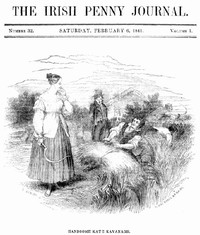
While this magical song was thrilling on all hearts, Kate Kavanagh, the witching Kate! stood apart from the others, singing and laughing alternately, her reaping-hook resting on one arm, and dressed in the every-day fashion of the place--the striped linsey short petticoat, and loose bedgown or wrapper, a dress that would make an ordinary woman frightful, and straw hat, the leaf of which, turned up before and pinned to the crown, displayed her sable locks and fair high forehead to perfection. And many a side-glance the anxious father, Dennis Costigan, cast at this arrangement of Kate’s headgear, as he broadly hinted that “for sartin Miss Kavanagh’s complexion would be intirely spiled if she showed it too much to the sun.”
“Tut!” was Kate’s good-humoured reply, “‘the life ov an ould hat is to cock it,’ as we say in the counthry. The leaf ov it was flappin’ in my eyes; the lads couldn’t see me, nor I them, so a pin settled the bisness;” and nothing could become her fine Spanish face better, though her toilet was made in perfect carelessness, for dashing Kate had other charms to depend on besides beauty. Imprimus, she was the first dancer in the country, outdoing her dancing-master himself at “jigs, reels, thribbles, doubles, hornpipes, and petticoatees.” She was a killing dancer in both senses of the word, for no boy or girl could keep it up with the spirit of Kate Kavanagh, and she generally disabled six or eight prime beaus at every “hop” she appeared at, which was nearly every night. The worst of it was (as the sorely annoyed fathers and mothers of the neighbourhood said), “though she fairly kilt all the boys that danced with her, yet sorra one but herself would sarve them for a partner after all!” Then she was, as Orator Shiel said, “Apollyo in petticoats for singin’!” and songs of love, murder, hunting, war, and sea, would charm with double effect, borne on the musical notes of Kate Kavanagh. In short, she was “metal most,” but also too “attractive;” and loud complaints and grievances at last came thundering on her devoted head. “Boys growin’ lazy and crazy--work undone or done badly--time spent an’ mis-spent--messages forgotten and mistaken--girls neglected--matches broken--eternal dancin’, fightin’, black eyes an’ bloody noses”--all, all was laid in a bundle at the door of handsome, animated, dashing, yet very innocent Kate Kavanagh.
The book keeps going
Reading is free forever. Sign up and watch scenes appear while you read.



Scenes Storieta drew for other classics.
New illustrated classics
Once or twice a month: the latest books to get full character casts, scene art, and free comic editions. No account needed.