THE IRISH PENNY JOURNAL.
NUMBER 35. SATURDAY, FEBRUARY 27, 1841. VOLUME I.
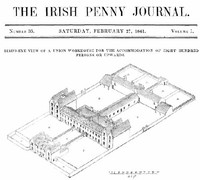
The entrance front building, forming a distinct structure, is placed about 150 feet in advance of the main building, and consists of one door (above the ground), on which the Board-room and clerk’s office are placed; underneath these are the waiting-hall, in which applicants for relief are received, and a room for a porter, who has charge of the paupers on their admission, for the purpose of seeing that they are washed, cleaned, and clothed in the workhouse dress; he is therefore placed near the probationary wards. Distinct wards are also provided for vagrants receiving temporary relief. This arrangement of the probationary and vagrant wards secures the vicinity of the body of the house from the risk of infection from persons previous to their being examined and declared free from disease.
The main building is separated from the entrance front by a courtyard and garden, which divide the two front yards for the boys and girls; the centre of the main building contains the master’s house, which is placed immediately among all classes, and from which ready access is had to any of the rooms; the kitchen offices are close under the master and matron’s inspection, as well as the several stores.
The wash-house and kitchen offices are placed in a situation distinct from the paupers in the yards, and none but those immediately employed in them have access thereto; on each side the master’s house are placed the rooms for children, who have separate staircases, used also by the master and matron; the extreme wings contain on the ground floor rooms for the old and infirm people, and some accommodation also for the able-bodied, which class, however, being employed (the women in the wash-house, &c., and the men at a mill, in breaking stones, or other useful occupation,) the same extent of day room is not requisite. The chapel and dining hall answers three purposes, inasmuch as it also serves, by means of a double partition, for day rooms for able-bodied men and women, should occasion require it. The situation of this building as a dining-hall is, from its central position, best suited for all classes, and is most convenient as regards the serving the food from the kitchen; the two rooms for boys and girls will also serve the purpose of a chapel, if required.
The Infirmary is placed at the back of the building, occupying a position distinct from the wards of the house, and sufficiently convenient for the supply of food from the kitchen offices without entailing the necessity of a separate establishment.
Wards are placed on each end of the infirmary buildings for idiots, epileptics, and lunatics, in which cells are provided for those for whom occasional restraint is unavoidable, or whose habits render distinct accommodation necessary.
The arrangement of the building is made with true regard to ventilation. At each end, in the centre of the building, a large hall, containing a superficial area of 425 feet, is carried up to the roof of the house, on which is constructed a large ventilator, containing windows hung on centres, and moveable with a line, to admit any circulation or change of air required. The several rooms throughout are arranged to open at once into the landing of the stone stairs, which are carried up in this space. The several doors have semicircular arches above them to be opened as occasion may require; and which, without producing any strong current, would always effect an extensive ventilation during the occupation of the rooms. The usual manner of ventilating the common sleeping rooms, is by placing the windows on each side of the room, which are very useful, but chiefly so after the paupers have left the apartment. The windows throughout are constructed with the upper part hinged, and to fall inside, which allows them to be opened during rainy weather.
Cast-iron air-gratings are to be inserted in small flues formed in the walls, and fixed a few inches above the floors, for obtaining, when required, an admission of external air.
A A A A, yards. B, women’s yard. C, men’s yard. D, girls’ yard. E, garden. F, boys’ yard. G and H, small yards.
THE DESTITUTE POOR OF IRELAND.
When we call to mind the interminable discussions which only a few years ago were usual in every society, as to the necessity, or advantages, or practicability, of a poor-law system in Ireland, and then transfer our attention to the actual progress which has been made in carrying into effect a certain, defined, and enacted arrangement, it is something like escaping from a dark, close wood, in which there was neither path nor direction, into an open country, with the bright canopy of heaven above, and our desired destination, or the sure road conducting to it, plainly in view.
To devise, and, much more, to bring into operation, a legalized system of poor relief suited to the wants and circumstances of Ireland, will, when duly considered, appear to have been a truly great and formidable undertaking. Innumerable plans had been set forth from time to time for this purpose, anterior to the act passed among the first of her present Majesty’s reign; but it may well be questioned if there was any one of them which would not on trial have proved to be a complete failure. Into that speculation, however, we have no occasion to enter at present, as there is now a law, having its machinery already so near to completion, that it must be in full effect at no distant day throughout the whole country, to the provisions and execution of which it will be at once more interesting and more profitable to direct our attention.
We may confidently attribute whatever facilities have been found to attend the practical introduction of the law into Ireland, to the fact that its management was entrusted in the first instance to a Commission; that the Commissioners were men already perfectly conversant with the subject, and that they were invested with sufficient powers to accomplish the object. No better machinery could have been devised, and we shall soon be enabled to perceive that it has not disappointed the expectations to which it might fairly have given rise.
The first great object which presented itself for consideration, in connection with the act of Parliament, may be supposed to have been the division of the country into suitable districts for the administration of the system. It required a new series of boundaries for its own provisions and purposes, as the proposed relief was to be afforded territorially, according to none of the existing divisions, either parochial, baronial, or by counties. The Commissioners were empowered to “unite such and so many townlands as they might think fit to be a Union for the relief of the destitute poor;” and the subject was one that evidently demanded the most serious examination.
The principle of forming the Unions was that which the Commissioners had previously adopted in England, namely, that the Union should consist of a market-town as a centre, and the district of country surrounding and depending on it, and extending to about ten miles round it in all directions. The size of Unions was indeed a subject which caused a good deal of anxious consideration. People, generally speaking, were at first desirous of having smaller Unions--not taking into account, that by increasing the number of Unions, more expense would be incurred, as the larger the Union, the smaller is the establishment charge in proportion. However, the Commissioners, guided by local facilities, formed Unions of townlands already combined by social affinities as well as geographical position, and have thus exceeded the number at first estimated on a theoretical scale. The number declared up to the 25th of March last is 104, and 26 more, it is supposed, will comprise the whole of Ireland, and constitute the entire.
The most important subject which demanded attention was the construction of a governing power for each Union, in conformity with the terms and intention of the act of Parliament. It was to consist of a Board of Guardians, one-third being resident magistrates, and the remainder freely elected by the rate-payers. The Commissioners were authorised to fix the number for each Union, and they were of opinion that a number of elected Guardians, varying from 16 to 24, would be best calculated for carrying out the provisions of the act. These, with the addition of one-third, composed of the local magistrates, who are Guardians ex officio, would, it was calculated, give to each Union a Board of from 21 to 32 members, which would be sufficient for deliberation, and yet not so numerous as to impede efficient action. With regard to the actual elections, now numerous, which have taken place, the Commissioners in their last Report express their regret that much excitement and discordant feeling should have been exhibited in some instances; but at the same time they declare their belief, that, as a general result, efficient Boards of Guardians have been constituted.
The third important object which demanded attention, was the procuring of suitable workhouses for the several Unions. The Commissioners were of opinion that one central workhouse, of a size sufficient for the whole of the Union, would be best; but for the sake of hastening the practical benefits of the act, and to save expense as much as possible, they were disposed to avail themselves of existing buildings nearly central, capable of being converted into workhouses, if obtainable. Their expectations on this head, however, were very far from being realized. It seems certain that the opinion originally formed as to the excess of barrack accommodation in Ireland was unfounded, there being in fact no more than the exigencies of the public service require; and of barracks, eventually, they obtained but one, situate in the town of Fermoy, which is now in process of conversion into a workhouse for that Union. In other Unions, old houses and other buildings were carefully surveyed; but in no one instance, says Mr Wilkinson, the intelligent and skilful architect of the Commissioners, have premises of this kind been found eligible in point of economy or convenience of arrangement, the sums asked in nearly every instance having been far beyond the value for the purpose of conversion. As a general result, the only old buildings which have been actually converted, or are now in process of conversion, into workhouses, are, in Dublin, the House of Industry for the North Union, and the Foundling Hospital for the South; in Fermoy the barrack already mentioned; and the House of Industry in Clonmel.
The number of new buildings contracted for, and in progress, was in March last 64; the notices for contracts since published amount to 50; so that building arrangements remain to be made for only 16 Unions.
In the appendix to the last Annual Report of the Commissioners there is a tabular statement, showing at one view the number and names of the Unions which have been declared up to April last--the area in statute acres, and population of each--the number of Guardians respectively--with other particulars, including indeed every thing necessary to afford satisfactory information on the subject; and, but that it would occupy a great deal of space, we would gladly transfer it to our columns.